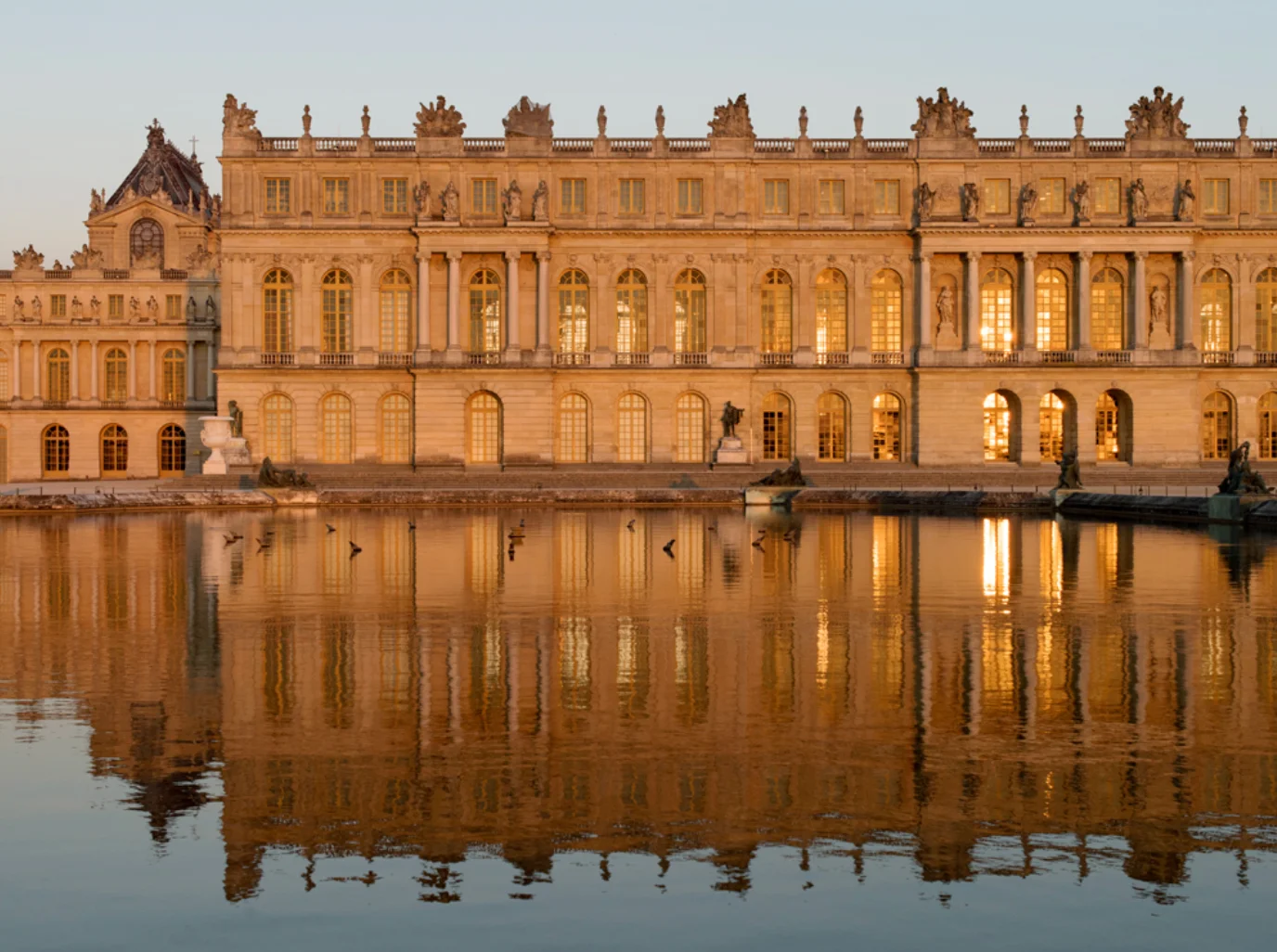
Palace of Versailles
At a glance

Louis XIV transferred the royal court to Versailles in 1682. After the Revolution emptied the palace of much of its furniture, Louis-Philippe transformed it into a Museum of the History of France, inaugurated in 1837.

Visit note - time related
+2 hoursDensity: Extremely high, both intellectually and physically. A full-estate day can involve 12–18 kilometres of walking. Use the little train or an electric vehicle if mobility or energy is a concern.
What you'll see
  • The Palace - The principal visitor circuit passes through the King’s State Apartments, the Hall of Mirrors, the Peace and War Rooms and the Queen’s Apartments.
  • The gardens - André Le Nôtre’s landscape is an immense composition of avenues, parterres, fountains, sculptures, controlled vistas and secluded groves.
  • The Estate of Trianon- The Grand Trianon, built from 1687 under Jules Hardouin-Mansart, offered Louis XIV an escape from the formality of court. The Petit Trianon, completed in 1768 by Ange-Jacques Gabriel, is a remarkably pure statement of French Neoclassicism. Marie Antoinette received it from Louis XVI in 1774.
  • Marie Antoinette’s Estate - The English Garden, Temple of Love and Queen’s Hamlet reveal a more picturesque, theatrical and private form of aristocratic life.
  • The Museum of the History of France - Created by Louis-Philippe, these extensive galleries use portraits, sculpture and enormous narrative paintings to construct a visual history of the French nation.

Artlovers Tip

One of the places that genuinely deserves the phrase “see it once in a lifetime”—but only if you give it enough time.

The Hall of Mirrors is iconic, yet Versailles becomes truly interesting when you move beyond it: from official spectacle to private retreat, geometric garden to artificial village, royal residence to revolutionary and national museum.

The principal risk is experiencing it as a crowded procession through gilded rooms. A timed morning entry, selective palace route and unhurried afternoon at Trianon produce a much richer visit.

About the venue

About

Louis XIV transferred the royal court to Versailles in 1682. After the Revolution emptied the palace of much of its furniture, Louis-Philippe transformed it into a Museum of the History of France, inaugurated in 1837.

Worth the trip

Versailles is the definitive expression of art used as political language.

Every surface contributes to the performance: painted ceilings transform Louis XIV into Apollo; mirrors demonstrate French manufacturing power; gardens impose geometric order on nature; portraits establish the image of monarchy; ceremonies turn architecture into a hierarchy of access.

Yet Versailles is more than the world of the Sun King. It contains the intimate spaces of Marie Antoinette, major French historical paintings, Neoclassical architecture, revolutionary history and temporary exhibitions that frequently introduce contemporary perspectives.
Palace of Versailles


Paris, France

OpenMuseum

Nearby route ideas

Route 1 — The complete Versailles experience

Palace → formal gardens → Grand Trianon → Petit Trianon → Queen’s Hamlet

Allow: 7–8 hours

Best for: First visits

Book the Palace for 09:00. Spend approximately two and a half hours in the royal apartments and Hall of Mirrors, then cross the gardens towards the Grand Canal.

Continue to the Grand Trianon after its noon opening, followed by Petit Trianon and the Queen’s Hamlet. In autumn 2026, this route connects particularly well with Gardens of the Enlightenment until 27 September and Sofia Coppola’s Marie Antoinette from 22 September.

Use the little train for one section if you want to preserve enough energy for the Hamlet.

Route 2 — Versailles, Revolution and the city beyond the gates

Palace historic galleries → Royal Tennis Court → Saint-Louis district

Allow: 5–6 hours

Concentrate the Palace visit on the historic galleries, Coronation Room and the new Gallery of the Enlightenment and the Revolution. After leaving the estate, walk to the Royal Tennis Court, where the deputies of the Third Estate took their decisive oath on 20 June 1789.

Continue through the Saint-Louis district, developed around the royal court, rather than immediately returning to Paris. This route transforms Versailles from a story of royal luxury into a more complex journey through monarchy, revolution and the construction of modern France.

Route 3 — Palace and the quieter Versailles

Palace → Musée Lambinet → Notre-Dame district

Allow: 5–6 hours

Best for: Repeat visitors or travellers more interested in art than the complete gardens

After a selective morning Palace visit, walk to the Musée Lambinet, housed in an 18th-century private mansion. Its displays examine domestic life in Versailles, the city’s history and the French Revolution on a smaller, more human scale.

Finish around the Notre-Dame district and market. This pairing works especially well when the weather makes a long garden visit unattractive: the Palace presents the official image of royal power, while Lambinet reveals the life and history of the town that developed around it.

Paris, France

Discover the destination

Experience art in Paris

France

Explore Paris

Travelling to Paris?

Join our community of art enthusiasts and discover the best exhibitions and museums in Paris. Get personalized recommendations and never miss a must-see show again.

Join us