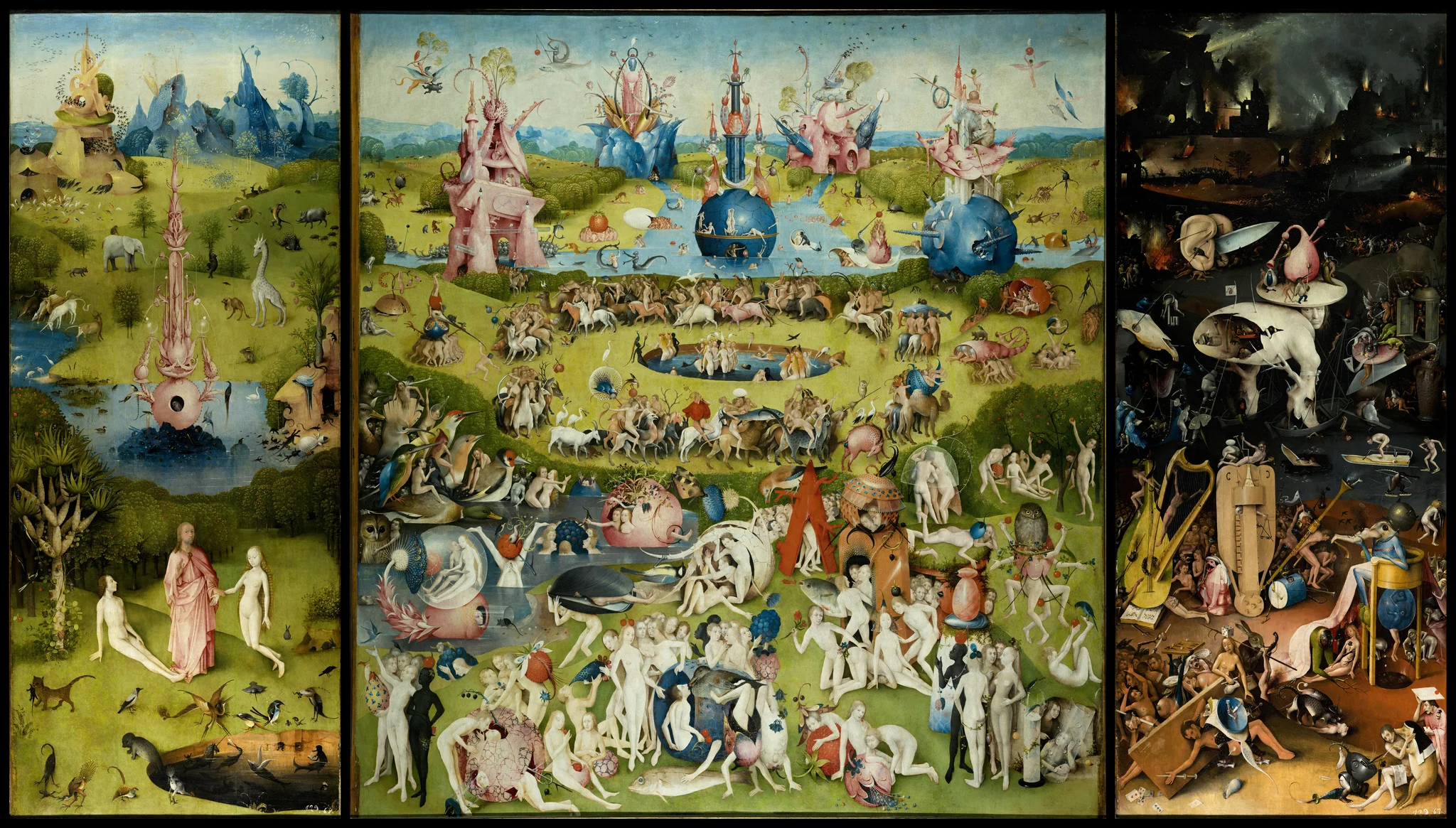
Early Netherlandish

Artlovers Stories · Art Movements

Early Netherlandish

1430–1530

Painting from the Burgundian Netherlands during the 15th and early 16th centuries, marked by oil-on-panel realism, jewel-like detail, and devotional or vanitas themes — Jan van Eyck, Rogier van der Weyden, Hans Memling and Hieronymus Bosch among its leading figures.

Every era paints the world its own way. Walk through the movements that changed how we look at art — and find where to see the works that defined them today.

Timeline

From Byzantine to now: a visual walk.

Scroll sideways to walk through 15 centuries of art.

01c. 500–1400

Medieval Art

Art as faith, symbol, and spiritual storytelling.

Key artists

  • Giotto
  • Cimabue
  • Duccio
  • Hildegard of Bingen
02c. 500–1450

Byzantine Art

Golden icons and sacred images made to feel eternal.

Key artists

  • Andrei Rublev
  • Theophanes the Greek
  • Cimabue
03c. 1000–1200

Romanesque

Powerful church art: solid, symbolic, and deeply religious.

Key artists

  • Gislebertus
  • Master of Taüll
04c. 1150–1500

Gothic

Art reaching upward — light, height, emotion, and divine drama.

Key artists

  • Giotto
  • Simone Martini
  • Jan van Eyck
  • Claus Sluter
05c. 1400–1490

Early Renaissance

The rebirth of perspective, nature, and the human figure.

Key artists

  • Masaccio
  • Donatello
  • Fra Angelico
  • Botticelli
  • Piero della Francesca
06c. 1490–1527

High Renaissance

The pursuit of perfect beauty, balance, and genius.

Key artists

  • Leonardo da Vinci
  • Michelangelo
  • Raphael
  • Titian
  • Bramante
07c. 1520–1600

Mannerism

Elegant, strange, and exaggerated — Renaissance rules start to bend.

Key artists

  • Pontormo
  • Parmigianino
  • Bronzino
  • El Greco
  • Cellini
08c. 1600–1750

Baroque

Drama, movement, light, and emotion turned up to full volume.

Key artists

  • Caravaggio
  • Rubens
  • Rembrandt
  • Velázquez
  • Bernini
09c. 1700–1780

Rococo

Playful, decorative, intimate — art for pleasure and elegance.

Key artists

  • Fragonard
  • Boucher
  • Watteau
  • Tiepolo
  • Élisabeth Vigée Le Brun
10c. 1750–1830

Neoclassicism

Ancient Greece and Rome reborn as order, reason, and heroic ideals.

Key artists

  • Jacques-Louis David
  • Ingres
  • Canova
  • Angelica Kauffman
11c. 1780–1850

Romanticism

Emotion over reason: nature, passion, freedom, and the sublime.

Key artists

  • Goya
  • Delacroix
  • Turner
  • Caspar David Friedrich
  • Théodore Géricault
12c. 1840–1880

Realism

Art turns toward real life, ordinary people, and social truth.

Key artists

  • Courbet
  • Millet
  • Daumier
  • Rosa Bonheur
  • Ilya Repin
13c. 1860–1886

Impressionism

Painting the fleeting moment — light, atmosphere, and modern life.

Key artists

  • Monet
  • Renoir
  • Degas
  • Morisot
  • Pissarro
14c. 1886–1905

Post-Impressionism

Beyond the impression: emotion, structure, color, and personal vision.

Key artists

  • Van Gogh
  • Cézanne
  • Gauguin
  • Seurat
  • Toulouse-Lautrec
15c. 1880–1910

Symbolism

Dreams, myths, and inner worlds take over the canvas.

Key artists

  • Odilon Redon
  • Gustave Moreau
  • Klimt
  • Fernand Khnopff
  • Munch
16c. 1890–1910

Art Nouveau

Nature becomes design: flowing lines, beauty, and total decoration.

Key artists

  • Alphonse Mucha
  • Klimt
  • Gaudí
  • Hector Guimard
  • Aubrey Beardsley
17c. 1905–1910

Fauvism

Color breaks free — wild, emotional, and unapologetically bright.

Key artists

  • Matisse
  • Derain
  • Vlaminck
  • Dufy
  • Kees van Dongen
18c. 1905–1930

Expressionism

Art as inner emotion: anxiety, intensity, and raw feeling.

Key artists

  • Munch
  • Kirchner
  • Kandinsky
  • Schiele
  • Kokoschka
19c. 1907–1920

Cubism

Reality shattered and rebuilt from multiple points of view.

Key artists

  • Picasso
  • Braque
  • Juan Gris
  • Léger
  • Sonia Delaunay
20c. 1909–1944

Futurism

Speed, machines, energy, and the shock of the modern world.

Key artists

  • Boccioni
  • Balla
  • Severini
  • Carrà
  • Marinetti
21c. 1916–1924

Dada

Anti-art for a broken world — absurd, rebellious, and radical.

Key artists

  • Duchamp
  • Hannah Höch
  • Tristan Tzara
  • Man Ray
  • Jean Arp
22c. 1917–1931

De Stijl

Pure abstraction: lines, grids, primary colors, and universal harmony.

Key artists

  • Mondrian
  • Theo van Doesburg
  • Gerrit Rietveld
  • Bart van der Leck
231919–1933

Bauhaus

Art meets design, architecture, function, and modern life.

Key artists

  • Walter Gropius
  • Paul Klee
  • Kandinsky
  • Josef Albers
  • László Moholy-Nagy
24c. 1924–1960s

Surrealism

Dreams, desire, and the unconscious made visible.

Key artists

  • Dalí
  • Magritte
  • Miró
  • Leonora Carrington
  • Max Ernst
25c. 1910–present

Abstract Art

Art without direct representation — form, color, and feeling lead.

Key artists

  • Kandinsky
  • Hilma af Klint
  • Mondrian
  • Malevich
  • Rothko
26c. 1920s–1950s

Social Realism

Art as political witness: workers, injustice, and collective struggle.

Key artists

  • Diego Rivera
  • Ben Shahn
  • Käthe Kollwitz
  • Jacob Lawrence
  • David Alfaro Siqueiros
27c. 1940s–1960s

Abstract Expressionism

Gesture, scale, and emotion — painting as an act of freedom.

Key artists

  • Jackson Pollock
  • Mark Rothko
  • Willem de Kooning
  • Lee Krasner
  • Helen Frankenthaler
28c. 1950s–1970s

Pop Art

Mass culture becomes art: advertising, comics, celebrities, and brands.

Key artists

  • Andy Warhol
  • Roy Lichtenstein
  • Richard Hamilton
  • Claes Oldenburg
  • Yayoi Kusama
29c. 1960s–1970s

Fluxus

Art becomes an event — playful, experimental, anti-market, and radically open.

Key artists

  • George Maciunas
  • Yoko Ono
  • Nam June Paik
  • Alison Knowles
  • Joseph Beuys
30c. 1960s–1970s

Minimalism

Less is everything — simple forms, space, repetition, and presence.

Key artists

  • Donald Judd
  • Dan Flavin
  • Agnes Martin
  • Carl Andre
  • Sol LeWitt
31c. 1960s–present

Conceptual Art

The idea becomes the artwork.

Key artists

  • Joseph Kosuth
  • Sol LeWitt
  • Lawrence Weiner
  • Jenny Holzer
  • On Kawara
32c. 1960s–1970s

Land Art

Nature becomes the canvas — art moves outside the museum.

Key artists

  • Robert Smithson
  • Nancy Holt
  • Michael Heizer
  • Walter De Maria
  • Richard Long
33c. 1960s–present

Performance Art

The artist's body, action, and time become the work.

Key artists

  • Marina Abramović
  • Joseph Beuys
  • Yoko Ono
  • Chris Burden
  • Tehching Hsieh
34c. 1960s–1980s

Body Art

The body becomes the canvas, the medium, and the battlefield.

Key artists

  • Marina Abramović
  • Gina Pane
  • Vito Acconci
  • Ana Mendieta
  • Carolee Schneemann
35c. 1967–1972

Arte Povera

"Poor" materials, radical ideas — art against consumer culture.

Key artists

  • Michelangelo Pistoletto
  • Jannis Kounellis
  • Mario Merz
  • Alighiero Boetti
  • Marisa Merz
36c. 1960s–1970s

Photorealism

Painting imitates the camera with obsessive precision.

Key artists

  • Chuck Close
  • Richard Estes
  • Audrey Flack
  • Ralph Goings
  • Duane Hanson
37c. 1970s–1990s

Postmodernism

Art questions everything: originality, authorship, taste, and power.

Key artists

  • Cindy Sherman
  • Barbara Kruger
  • Jeff Koons
  • Sherrie Levine
  • Jenny Holzer

Vertical view

The full chronology: main and secondary.

Main movements stand out; secondary ones flow alongside.

  1. Secondaryc. 500–1400

    Medieval Art

    Art as faith, symbol, and spiritual storytelling.

    • Giotto
    • Cimabue
    • Duccio
    • Hildegard of Bingen
  2. Secondaryc. 500–1450

    Byzantine Art

    Golden icons and sacred images made to feel eternal.

    • Andrei Rublev
    • Theophanes the Greek
    • Cimabue
  3. Secondaryc. 1000–1200

    Romanesque

    Powerful church art: solid, symbolic, and deeply religious.

    • Gislebertus
    • Master of Taüll
  4. Mainc. 1150–1500

    Gothic

    Art reaching upward — light, height, emotion, and divine drama.

    • Giotto
    • Simone Martini
    • Jan van Eyck
    • Claus Sluter
  5. Mainc. 1400–1490

    Early Renaissance

    The rebirth of perspective, nature, and the human figure.

    • Masaccio
    • Donatello
    • Fra Angelico
    • Botticelli
    • Piero della Francesca
  6. Mainc. 1490–1527

    High Renaissance

    The pursuit of perfect beauty, balance, and genius.

    • Leonardo da Vinci
    • Michelangelo
    • Raphael
    • Titian
    • Bramante
  7. Secondaryc. 1520–1600

    Mannerism

    Elegant, strange, and exaggerated — Renaissance rules start to bend.

    • Pontormo
    • Parmigianino
    • Bronzino
    • El Greco
    • Cellini
  8. Mainc. 1600–1750

    Baroque

    Drama, movement, light, and emotion turned up to full volume.

    • Caravaggio
    • Rubens
    • Rembrandt
    • Velázquez
    • Bernini
  9. Secondaryc. 1700–1780

    Rococo

    Playful, decorative, intimate — art for pleasure and elegance.

    • Fragonard
    • Boucher
    • Watteau
    • Tiepolo
    • Élisabeth Vigée Le Brun
  10. Mainc. 1750–1830

    Neoclassicism

    Ancient Greece and Rome reborn as order, reason, and heroic ideals.

    • Jacques-Louis David
    • Ingres
    • Canova
    • Angelica Kauffman
  11. Mainc. 1780–1850

    Romanticism

    Emotion over reason: nature, passion, freedom, and the sublime.

    • Goya
    • Delacroix
    • Turner
    • Caspar David Friedrich
    • Théodore Géricault
  12. Mainc. 1840–1880

    Realism

    Art turns toward real life, ordinary people, and social truth.

    • Courbet
    • Millet
    • Daumier
    • Rosa Bonheur
    • Ilya Repin
  13. Mainc. 1860–1886

    Impressionism

    Painting the fleeting moment — light, atmosphere, and modern life.

    • Monet
    • Renoir
    • Degas
    • Morisot
    • Pissarro
  14. Mainc. 1886–1905

    Post-Impressionism

    Beyond the impression: emotion, structure, color, and personal vision.

    • Van Gogh
    • Cézanne
    • Gauguin
    • Seurat
    • Toulouse-Lautrec
  15. Secondaryc. 1880–1910

    Symbolism

    Dreams, myths, and inner worlds take over the canvas.

    • Odilon Redon
    • Gustave Moreau
    • Klimt
    • Fernand Khnopff
    • Munch
  16. Secondaryc. 1890–1910

    Art Nouveau

    Nature becomes design: flowing lines, beauty, and total decoration.

    • Alphonse Mucha
    • Klimt
    • Gaudí
    • Hector Guimard
    • Aubrey Beardsley
  17. Secondaryc. 1905–1910

    Fauvism

    Color breaks free — wild, emotional, and unapologetically bright.

    • Matisse
    • Derain
    • Vlaminck
    • Dufy
    • Kees van Dongen
  18. Mainc. 1905–1930

    Expressionism

    Art as inner emotion: anxiety, intensity, and raw feeling.

    • Munch
    • Kirchner
    • Kandinsky
    • Schiele
    • Kokoschka
  19. Mainc. 1907–1920

    Cubism

    Reality shattered and rebuilt from multiple points of view.

    • Picasso
    • Braque
    • Juan Gris
    • Léger
    • Sonia Delaunay
  20. Secondaryc. 1909–1944

    Futurism

    Speed, machines, energy, and the shock of the modern world.

    • Boccioni
    • Balla
    • Severini
    • Carrà
    • Marinetti
  21. Secondaryc. 1916–1924

    Dada

    Anti-art for a broken world — absurd, rebellious, and radical.

    • Duchamp
    • Hannah Höch
    • Tristan Tzara
    • Man Ray
    • Jean Arp
  22. Secondaryc. 1917–1931

    De Stijl

    Pure abstraction: lines, grids, primary colors, and universal harmony.

    • Mondrian
    • Theo van Doesburg
    • Gerrit Rietveld
    • Bart van der Leck
  23. Secondary1919–1933

    Bauhaus

    Art meets design, architecture, function, and modern life.

    • Walter Gropius
    • Paul Klee
    • Kandinsky
    • Josef Albers
    • László Moholy-Nagy
  24. Mainc. 1924–1960s

    Surrealism

    Dreams, desire, and the unconscious made visible.

    • Dalí
    • Magritte
    • Miró
    • Leonora Carrington
    • Max Ernst
  25. Secondaryc. 1910–present

    Abstract Art

    Art without direct representation — form, color, and feeling lead.

    • Kandinsky
    • Hilma af Klint
    • Mondrian
    • Malevich
    • Rothko
  26. Secondaryc. 1920s–1950s

    Social Realism

    Art as political witness: workers, injustice, and collective struggle.

    • Diego Rivera
    • Ben Shahn
    • Käthe Kollwitz
    • Jacob Lawrence
    • David Alfaro Siqueiros
  27. Mainc. 1940s–1960s

    Abstract Expressionism

    Gesture, scale, and emotion — painting as an act of freedom.

    • Jackson Pollock
    • Mark Rothko
    • Willem de Kooning
    • Lee Krasner
    • Helen Frankenthaler
  28. Mainc. 1950s–1970s

    Pop Art

    Mass culture becomes art: advertising, comics, celebrities, and brands.

    • Andy Warhol
    • Roy Lichtenstein
    • Richard Hamilton
    • Claes Oldenburg
    • Yayoi Kusama
  29. Secondaryc. 1960s–1970s

    Fluxus

    Art becomes an event — playful, experimental, anti-market, and radically open.

    • George Maciunas
    • Yoko Ono
    • Nam June Paik
    • Alison Knowles
    • Joseph Beuys
  30. Mainc. 1960s–1970s

    Minimalism

    Less is everything — simple forms, space, repetition, and presence.

    • Donald Judd
    • Dan Flavin
    • Agnes Martin
    • Carl Andre
    • Sol LeWitt
  31. Mainc. 1960s–present

    Conceptual Art

    The idea becomes the artwork.

    • Joseph Kosuth
    • Sol LeWitt
    • Lawrence Weiner
    • Jenny Holzer
    • On Kawara
  32. Secondaryc. 1960s–1970s

    Land Art

    Nature becomes the canvas — art moves outside the museum.

    • Robert Smithson
    • Nancy Holt
    • Michael Heizer
    • Walter De Maria
    • Richard Long
  33. Secondaryc. 1960s–present

    Performance Art

    The artist's body, action, and time become the work.

    • Marina Abramović
    • Joseph Beuys
    • Yoko Ono
    • Chris Burden
    • Tehching Hsieh
  34. Secondaryc. 1960s–1980s

    Body Art

    The body becomes the canvas, the medium, and the battlefield.

    • Marina Abramović
    • Gina Pane
    • Vito Acconci
    • Ana Mendieta
    • Carolee Schneemann
  35. Secondaryc. 1967–1972

    Arte Povera

    "Poor" materials, radical ideas — art against consumer culture.

    • Michelangelo Pistoletto
    • Jannis Kounellis
    • Mario Merz
    • Alighiero Boetti
    • Marisa Merz
  36. Secondaryc. 1960s–1970s

    Photorealism

    Painting imitates the camera with obsessive precision.

    • Chuck Close
    • Richard Estes
    • Audrey Flack
    • Ralph Goings
    • Duane Hanson
  37. Secondaryc. 1970s–1990s

    Postmodernism

    Art questions everything: originality, authorship, taste, and power.

    • Cindy Sherman
    • Barbara Kruger
    • Jeff Koons
    • Sherrie Levine
    • Jenny Holzer

Because you are an artlover,

Join our community of art enthusiasts and discover exhibitions, artists, and masterpieces tailored to your tastes. Get personalized recommendations and never miss a must-see show again.