A futuristic shelter made from ancient materials: Klára Hosnedlová transforms textiles, stone, glass and embroidery into an immersive space where memory, labour and imagined futures collide.

Don't rush past it on your way upstairs. The staircase is part of the artwork. Change your position and height as you move through the building: the relationship between the installation, your body and the architecture changes continuously.
Inside the exhibition
Klára Hosnedlová: Shelter was commissioned for the Atrium Stair of the expanded New Museum and has been on view since 21 March 2026. The installation is ongoing.
Klára Hosnedlová (b. 1990, Czech Republic) is a contemporary artist known for immersive installations that combine textiles, sculpture, embroidery, architecture and performance. Her work explores memory, gender, labour and imagined futures, often blending traditional craft with a distinctly futuristic, almost science-fiction atmosphere.
The Atrium Stair is itself an important part of the New Museum's new architecture. Designed as part of the OMA expansion, the stair connects the different levels of the existing SANAA-designed building and the new extension. It was conceived almost as an extension of the street, linking the museum's galleries, public spaces and exterior.
Hosnedlová's Shelter responds directly to this architecture. Rather than placing an independent sculpture inside a gallery, she creates an artwork that occupies and activates the circulation space itself.
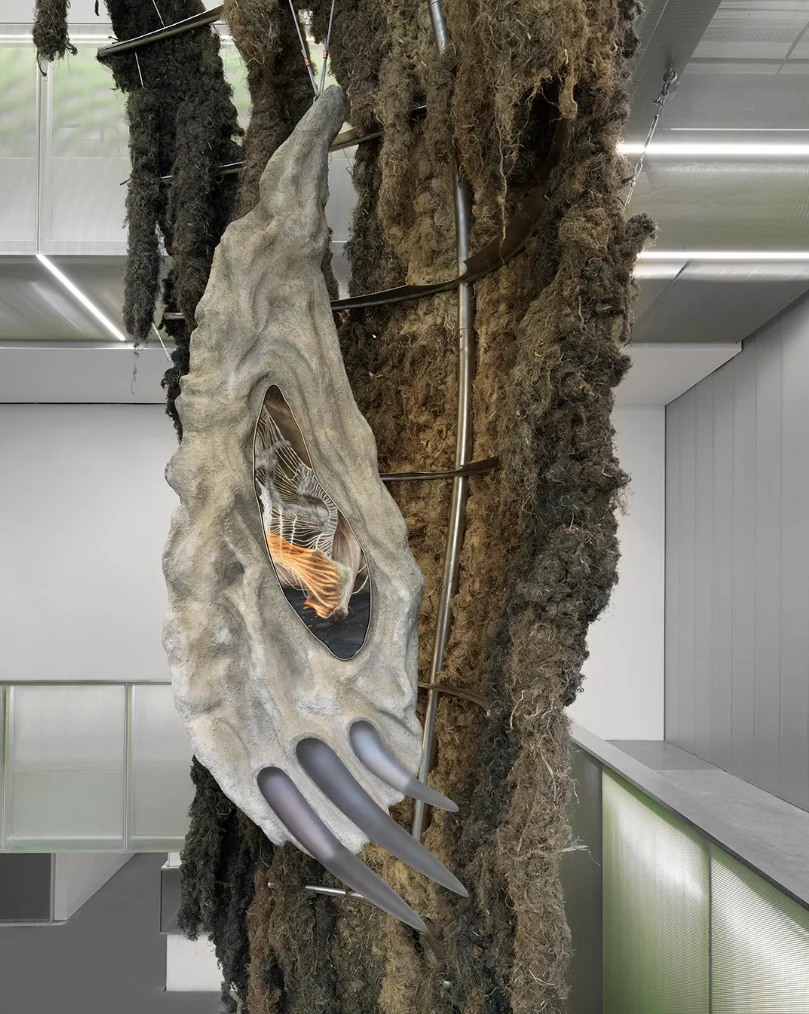
The installation combines a sandstone and glass sculpture with a pelt-like structure made from flax-based textile and Hosnedlová's characteristic embroidery. The materials connect contemporary sculpture with traditional craft practices, particularly those associated with Central and Eastern Europe.
The idea of the shelter is deliberately ambiguous. It can suggest protection and domesticity, but also something primitive, archaeological or futuristic. Hosnedlová's work frequently plays with this tension between past and future, nostalgia and futurity, nature and technology.
Her interest in Eastern Bloc architecture and craft traditions is particularly relevant here. The work connects histories of labour and collective making with a speculative visual language that can feel almost science-fictional. Questions around labour, gender and historical memory run through the installation.
The work also has a performative dimension. Shelter functioned as a stage set for a private performance before the museum opened to the public; photographs and film from that performance become part of the work's continuing visual history.
This is characteristic of Hosnedlová's wider practice. Her installations often operate like constructed worlds or film sets, combining sculpture, textiles, architecture, performance and carefully staged human presence. The visitor then enters the environment and becomes part of its narrative.
Worth travelling for?
A must-see if you're visiting the New Museum.
Shelter is particularly successful because the architecture isn't simply the backdrop — it completes the artwork. It is a small time commitment but a memorable encounter, especially if you take the stairs slowly and experience the work from several levels.
Artlovers mood: Immersive · Dreamlike · Tactile · Mysterious · Futuristic
Klára Hosnedlová: Shelter
Hours & rating from Google