At a glance
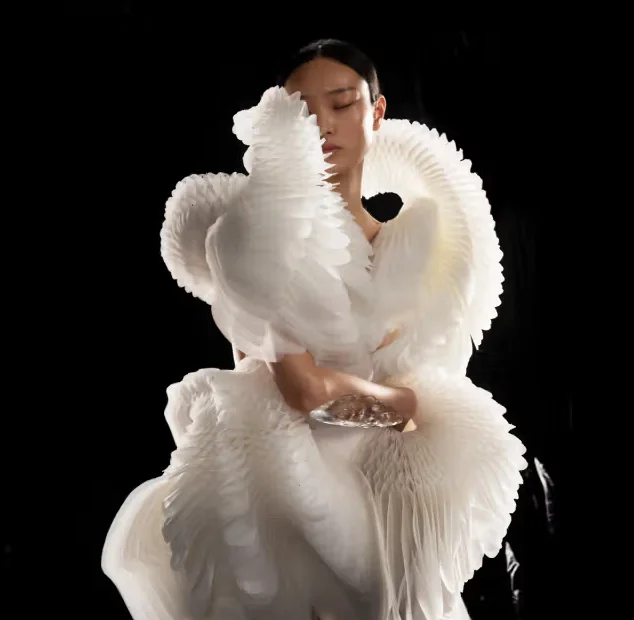
Haute couture becomes a living laboratory where bodies, water, skeletons and technology merge into garments that seem to belong to another species.
Why go
You'll see
Haute couture · Wearable sculpture · Biomimicry · Digital fabrication · 3D-printed fashion · Contemporary design
More than 140 sculptural couture creations
Pace of visit
This is a dense exhibition containing eleven thematic environments, numerous garments, moving-image material, scientific objects and intricate details that reward close observation. Allow additional time for the rest of the Brooklyn Museum.
Don't miss
- Morphogenesis Dress, 2020
- Skeleton Dress, 2011
- The atelier section
- The transition from microscopic life to the cosmos

Artlovers Tip
Worth the trip.
A rare fashion exhibition with enough conceptual and material substance to interest visitors who do not normally follow couture. Its strength lies in showing experimentation as a process rather than presenting technology as spectacle.
Inside the exhibition
Meet the artist
Description
Originally organized by the Musée des Arts Décoratifs in Paris, Sculpting the Senses has travelled through Brisbane, Singapore and Rotterdam before reaching Brooklyn. The New York presentation expands its dialogue with art and science through objects from the Brooklyn Museum’s own collections.
Rather than following a conventional career chronology, the exhibition moves through interconnected environments inspired by water, anatomy, motion, sound, natural systems and the universe. Garments appear beside artworks and scientific specimens, allowing similarities in structure and movement to emerge across disciplines.
The result positions couture as a form of spatial investigation: clothing becomes an interface connecting the body with its environment rather than a decorative surface placed upon it.
About Iris van Herpen
Born in the Netherlands in 1984, Iris van Herpen grew up close to nature and trained in classical dance before establishing her Amsterdam fashion house in 2007. Both influences remain visible in garments conceived around bodily movement, balance and transformation.
In 2010, she became the first designer to present a 3D-printed dress on a runway. Yet her work is not reducible to new technology: its defining characteristic is the combination of digital processes with exceptionally demanding couture craftsmanship.
Her studio regularly collaborates with architects, choreographers, visual artists, musicians and scientists. These partnerships have produced a distinctive design language in which clothing may resemble a skeleton, wave, organism or atmospheric event—momentarily suspended around the human body.
Iris van Herpen: Sculpting the Senses
Artlovers relevance
Plan your visit
Hours & rating from Google