At a glance
Step inside Brussels at its creative peak, when Symbolism, Art Nouveau and radical new ideas made the young Belgian capital one of Europe’s artistic laboratories.
Why go
You'll see
- More than 250 works drawn from major Belgian collections.
- Symbolist paintings filled with dreams, myths, mysterious women and ambiguous narratives.
- Art Nouveau architecture and decorative design associated with Brussels.
- Works demonstrating Brussels’ dialogue with artists and movements in Paris, Vienna, London and elsewhere in Europe.
Pace of visit
With over 250 objects across many different media, this is a dense exhibition.
Don't miss
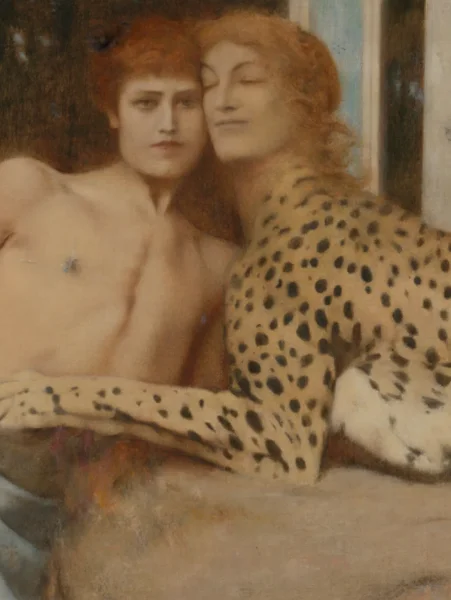
- Fernand Khnopff, The Caresses (1896)
- Constant Montald, Nymphs Dancing (c. 1898)
- The jewellery and applied arts
- Paul Dubois, Minerva or Liberty (1901)
- Posters and photographs that reveal how this avant-garde culture circulated beyond elite salons.

Artlovers Tip
This is more than an Art Nouveau exhibition. It reconstructs an entire cultural ecosystem and restores Brussels to its place alongside Paris, Vienna and London as a centre of European modernity.
Inside the exhibition
Description
In autumn 1900, visitors to the newly opened Grand Palais encountered approximately 150 Belgian paintings and sculptures in the foreign nations section of the Paris Universal Exhibition. Their enthusiastic reception confirmed that Brussels had become one of Europe’s most dynamic artistic centres.
Bruxelles 1900 returns to that moment with more than 250 works. Created with the Royal Museums of Fine Arts of Belgium, the Royal Museums of Art and History and the Royal Library of Belgium, the exhibition reconstructs the cultural energy that surrounded the Belgian capital at the end of the 19th century.
Bruxelles 1900
Plan your visit
Hours & rating from Google