At a glance
Fifty years of Spanish democracy spanning more than 3,000 square meters, featuring 403 works by 224 artists—blending established figures with works and voices rarely seen in the permanent galleries.
Why go
This is the Reina Sofía’s major new account of art produced from the beginning of Spain’s democratic transition to the present. Rather than organising the period as a parade of movements and famous names, the museum approaches it through social experience: new freedoms after Franco, counterculture, feminism, queer identities, heroin and AIDS, the expansion of museums and galleries, and changing ideas about who receives cultural visibility.
You'll see
The presentation is divided into three interconnected itineraries which repeatedly return to the 1970s rather than following a strictly chronological route.
Pace of visit
This is a dense collection display with 403 works and substantial historical interpretation. It cannot be meaningfully visited in 30 minutes. For a selective visit, allow 90 minutes and choose one complete itinerary rather than rushing through all 21 rooms.
Don't miss
Esther Ferrer, Intimate and Personal, 1977 and 1992: performance documentation that turns the measuring of bodies into a critique of control, privacy and objectification.
David Wojnarowicz, Arthur Rimbaud in New York, 1978–1979: the poet’s masked face moves through marginal New York, collapsing identities and historical periods.
Pepe Espaliú, Untitled (Three Cages), 1992: vulnerability, isolation and the politics of AIDS distilled into a restrained sculptural image.
Susana Solano, Take It Easy, with Emergency Ladder, 1989: an industrial structure that simultaneously attracts, encloses and denies physical access.
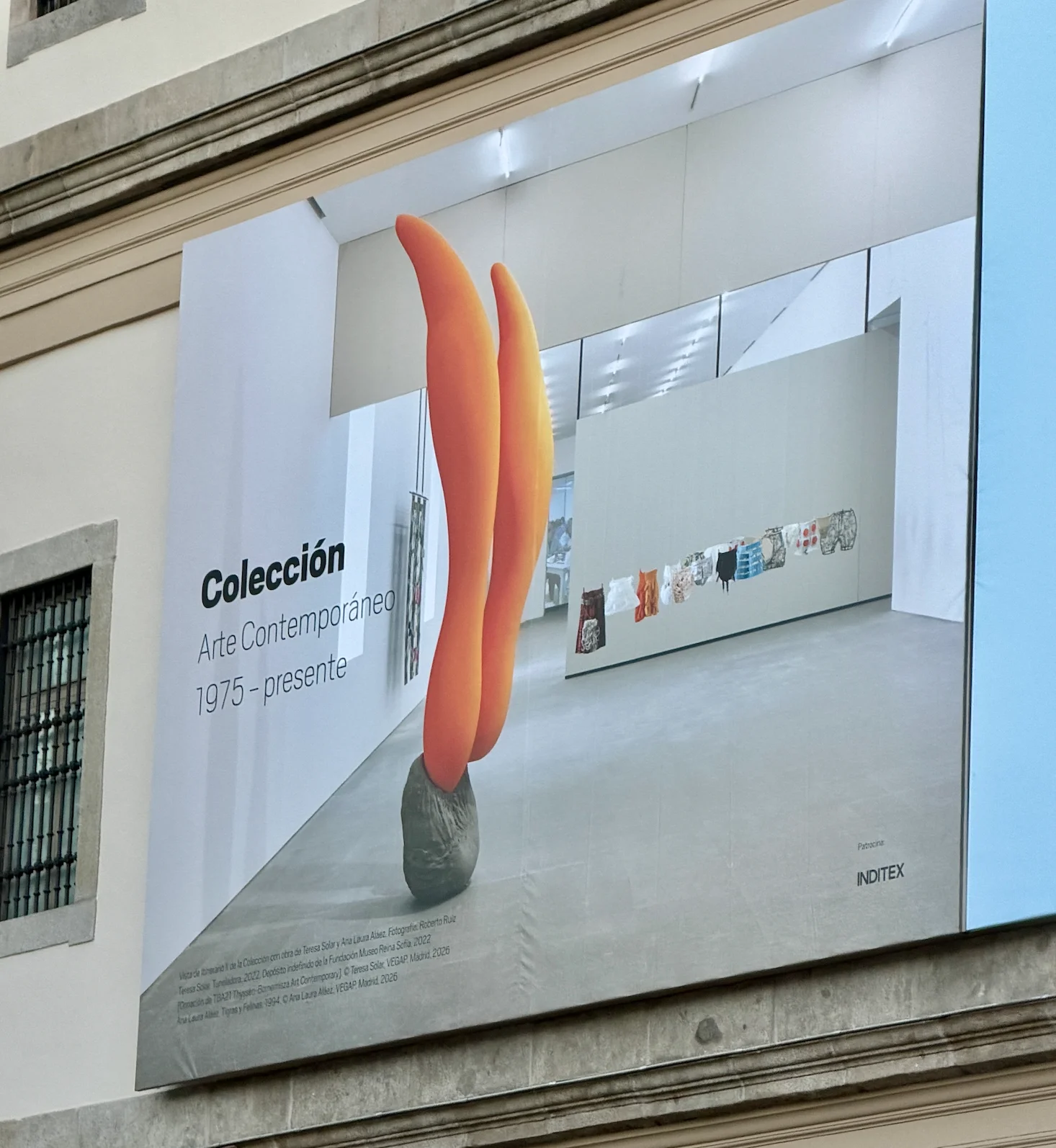
Teresa Solar, Tunnelling Machine, 2022: an enormous hybrid body that appears part creature, part infrastructure and part speculative anatomy.
Carlos Alcolea, Matisse by Day, Matisse by Night, 1977: colour, fantasy and a Möbius-strip structure celebrating painting’s capacity for continuous reinvention.
Ouka Leele’s Peluquería and Cristina García Rodero’s España oculta: two very different ways of photographing post-Franco Spain—one staged and flamboyant, the other documentary and anthropological.

Artlovers Tip
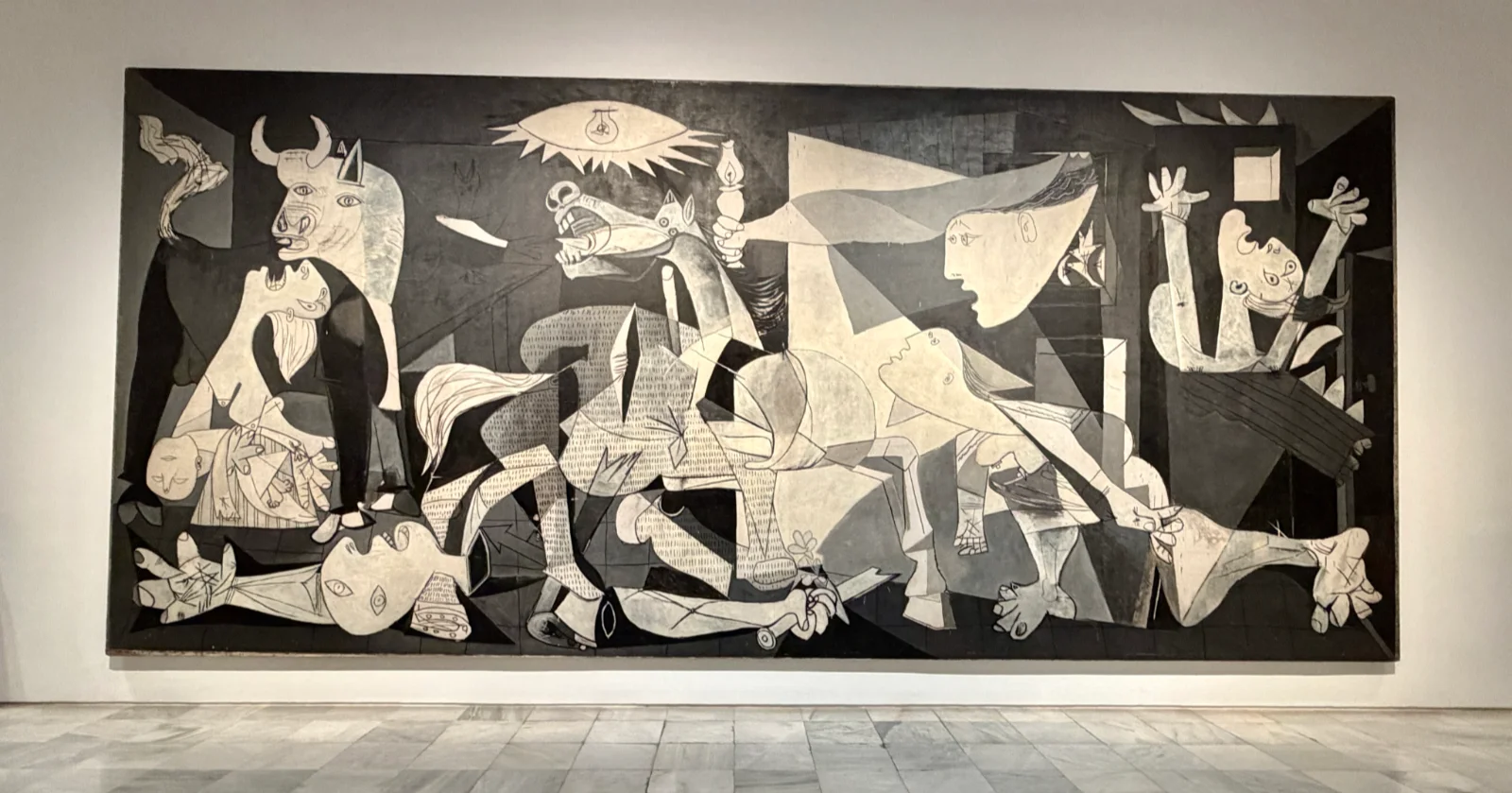
Worth the trip—especially for understanding Spain after 1975. This is more than a rearrangement of museum holdings. It offers a valuable cultural history of how Spain changed after the dictatorship and how artists responded to freedoms, exclusions and crises that accompanied democracy. The display is ambitious, occasionally moving and significantly more diverse than older narratives of Spanish contemporary art. For a first visit to the Reina Sofía, Guernica remains essential. But this fourth-floor presentation explains what happened next—and deserves more than the hurried final half-hour many visitors give it. Download the fourth-floor map before starting. The presentation is linear but not chronological, and knowing its three-part structure prevents it from feeling like a sequence of unrelated rooms. Pause in Alhacena, the room designed for resting and conversation, before beginning the third itinerary.
Inside the exhibition
Description
Collection. Contemporary Art: 1975–Present begins with Spain’s Transition but avoids presenting democracy as a simple progression from repression to freedom. Instead, the display asks how political change affected private life, cultural expression and the structures through which art was produced and recognised.
The presentation was developed collectively from 2023 under the direction of Manuel Segade and represents the first major reordering of the Reina Sofía collection during his directorship.
Its central idea is that a national museum should not produce a fixed and definitive version of recent history. Works from different decades are deliberately placed together, allowing the concerns of the present—gender, ecology, identity, institutional power and decolonisation—to reopen interpretations of the past.
The result is a collection conceived as provisional and revisable. Rather than closing the story of Spanish art after 1975, the museum presents it as an ongoing argument about whose experiences are remembered, who is represented and what kinds of future can still be imagined.
Worth travelling for?
The presentation is divided into three interconnected itineraries which repeatedly return to the 1970s rather than following a strictly chronological route.
I. A History of Affect in Contemporary Art
Bodies, intimacy and emotional relationships become political material. The rooms move through second-wave feminism, sexual liberation, subcultures, drug dependency, AIDS and collective mourning.
Artists include Esther Ferrer, Eulàlia Grau, Judy Chicago, David Wojnarowicz, Pepe Espaliú, Ocaña, Barbara Hammer and Yeguas del Apocalipsis.
II. The Powers of Fiction
A large sculptural sequence explores how bodies encounter objects, materials and architectural space. Spanish sculpture of the 1980s appears alongside younger artists reconsidering matter, ecology and post-human forms.
Expect works by Juan Navarro Baldeweg, Susana Solano, Cristina Iglesias, Juan Muñoz, Juan Luis Moraza, Teresa Solar and June Crespo.
III. A New Framework
The final itinerary looks at the creation of Spain’s contemporary-art system: museums, galleries, markets, video culture, new painting and photography after the Transition.
It brings together the Madrid New Figuration, the Movida, Galician Grupo Atlántica, staged and documentary photography, critiques of representation, Afro-Spanish identities and contemporary gender politics.
Collection. Contemporary Art: 1975–Present
Permanent
Artlovers relevance
Plan your visit
Hours & rating from Google