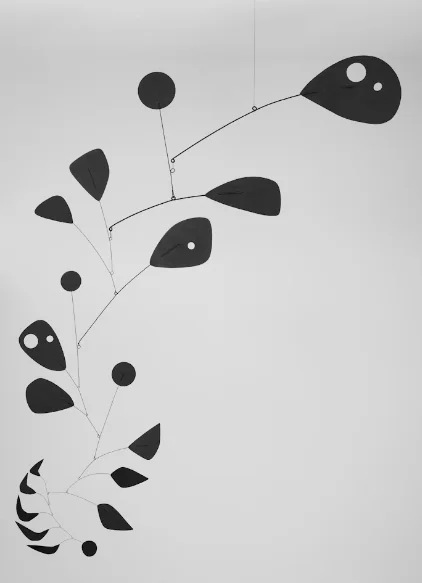
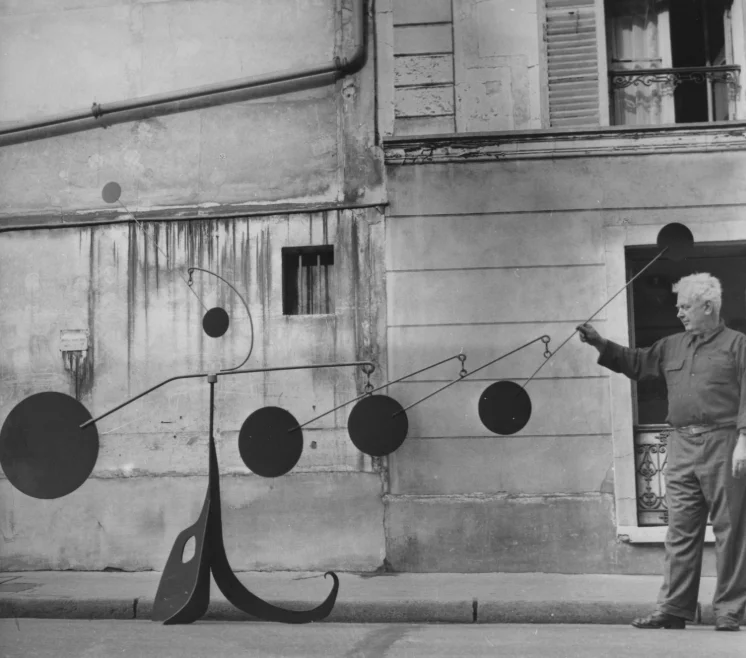
Calder made sculpture lose its weight. Metal begins to float, wire becomes drawing, and balance turns into poetry.

Inside the exhibition
Join us at the Fondation Louis Vuitton for a special celebration: 100 years since Alexander Calder first arrived in France. This exhibition brings together nearly 300 works that tell the story of a lifetime of imagination and creativity.
Take a journey through 50 years of art, starting with the playful magic of his 'Cirque Calder' performances that once captivated Paris in the 1920s, and leading all the way to the bold, monumental sculptures of the 1960s and 70s. Set inside Frank Gehry’s stunning architecture, Calder’s iconic mobiles float and sway through the galleries, turning the exhibition into a graceful, choreographed dance.
Rêver en équilibre follows around fifty years of Calder’s creation: from his early Paris years and the playful world of Cirque Calder, to the mobiles, stabiles and monumental sculptures that transformed public art in the 20th century.
You’re watching:
- Mobiles that move gently through air and light
- Stabiles that turn metal into rhythm and structure
- Wire portraits that feel like drawings in space
- Wooden figures, paintings, drawings and jewellery
- Works connected to performance, sound, gravity, reflection and the ephemeral
- A dialogue between Calder’s suspended forms and Frank Gehry’s architecture at Fondation Louis Vuitton
The exhibition also places Calder in conversation with artists of his time, including Jean Arp, Barbara Hepworth, Jean Hélion, Piet Mondrian, Paul Klee and Pablo Picasso, helping situate his radical invention inside the wider avant-garde world.
Worth travelling for?
Especially if you want to feel modern art physically, not just understand it intellectually.
Calder matters because he made sculpture active. Before him, sculpture was usually something solid, fixed, heavy. Calder made it move, breathe and respond. He turned space itself into part of the artwork.
This is one of the major Paris exhibitions of 2026: a large-scale Calder retrospective occupying Fondation Louis Vuitton’s spaces and even extending outdoors. The building’s glass, curves and light make the mobiles feel especially alive
Experience as an Artlover
Don’t rush. Calder’s works need movement and time.
Walk around the mobiles and watch how their balance changes.
Look at shadows — they are part of the sculpture.
Pay attention to small works too: the wire pieces and jewellery reveal Calder’s intelligence at intimate scale.
Let the architecture become part of the visit. Gehry’s building amplifies the sense of suspension, rhythm and air.
Calder. Rêver en Equilibre
Hours & rating from Google