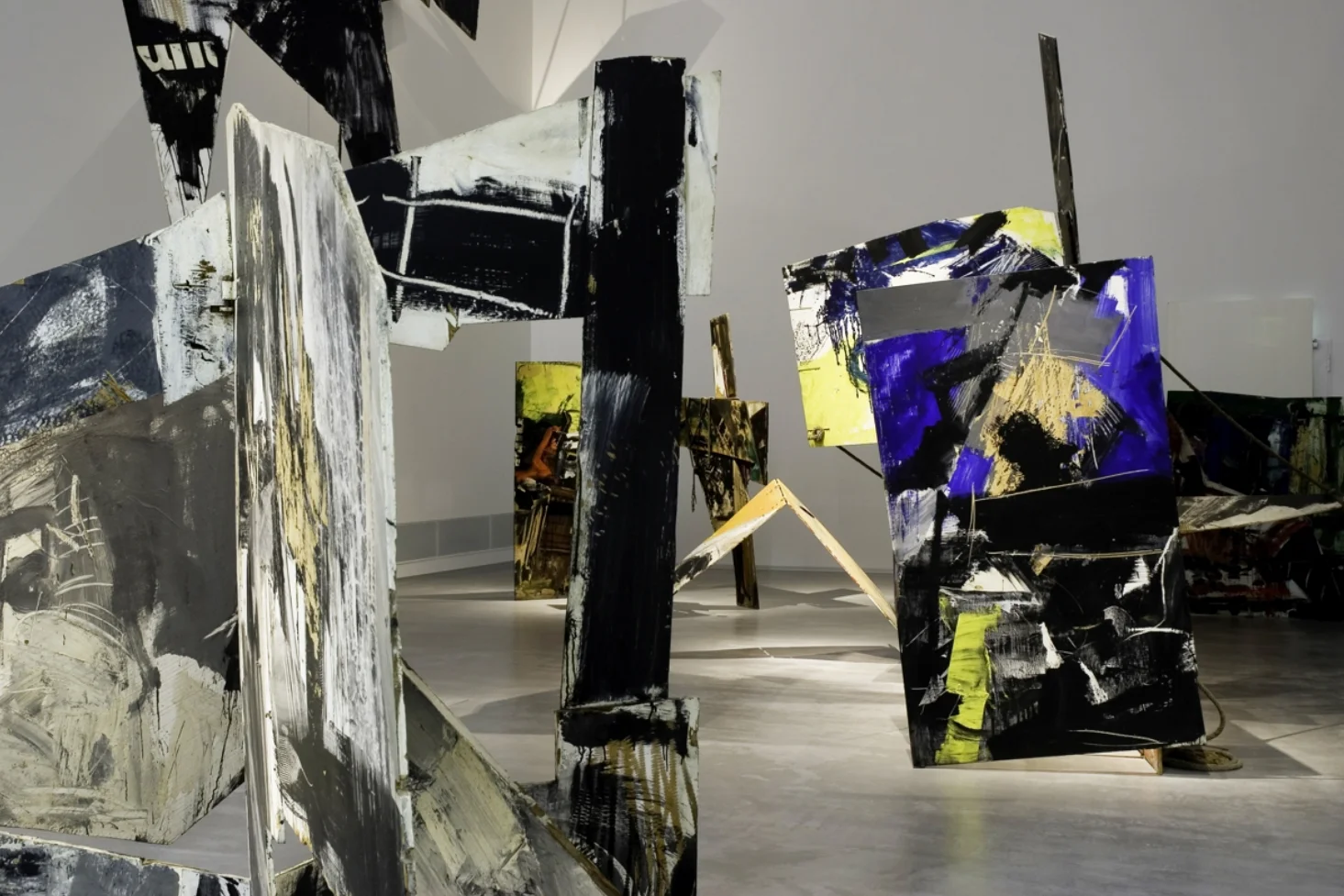
A monumental wooden diary capturing the fractured energy of 1960s Berlin through aggressive, free-standing sculptural paintings.

Look closely at the iron hinges; they aren't just functional connectors but symbols of a city that could be folded, closed, or forcibly rearranged.
Inside the exhibition
Italian painter Emilio Vedova (1919–2006) arrived in West Berlin in 1964, finding a city defined by jagged edges and political tension. His response was Absurd Berlin Diary ’64, a massive installation that dismantled the traditional canvas in favor of plurimi—asymmetrical wooden panels held together by iron hinges. These works represent a pivotal moment in European post-war art, where the trauma of the past meets the raw, gestural energy of the present.
You're watching a forest of painted timber and iron. The structures rise from the floor, inviting you to walk around and between them, feeling the weight of the dark, expressive strokes. Light catches the rough textures of the wood, and the hinges suggest a precarious mobility, mirroring the clash of contradictions Vedova felt in the streets outside the studio.
Worth travelling for?
- Spatial revolution: Experience the famous plurimi that liberated painting from the wall, turning the act of looking into a physical journey through space.
- Historical weight: See a work created in the former studio of a Nazi sculptor, representing a poignant reclamation of space by an anti-fascist artist.
- A Berlin cornerstone: Witness one of Vedova’s most significant and complex installations, which he donated to the museum to honor its deep connection to the city.
Experience as an Artlover
Give yourself time to navigate the plurimi from multiple angles; the double-sided panels change completely as you step around them. The scale is intentional, designed to make you feel the claustrophobia and the resilience of a divided metropolis. Afterward, walk south toward the Landwehr Canal to reflect on how the city's modern architecture still echoes the jagged contrasts Vedova captured sixty years ago.
Absurd Berlin Diary ’64
Hours & rating from Google