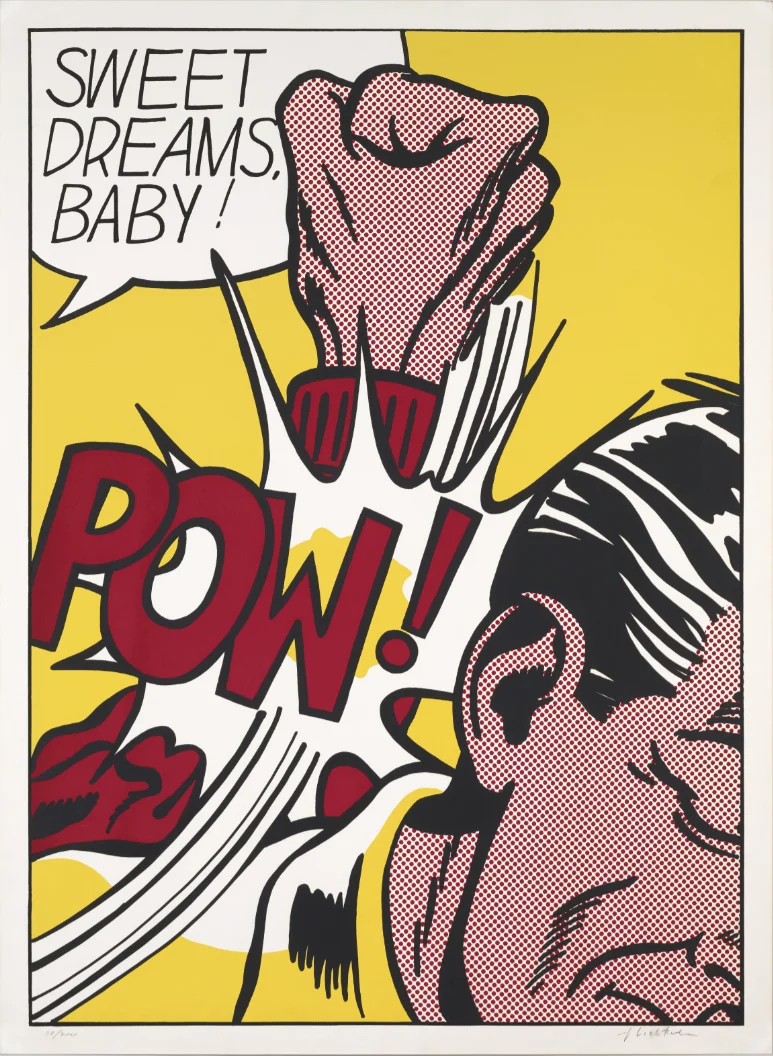
A featured work
A fighter plane fires a rocket across the left panel. On the right, another plane explodes in a dramatic burst of red, yellow and black. The word WHAAM! becomes part of the image — not just a title, but the sound of impact.
More info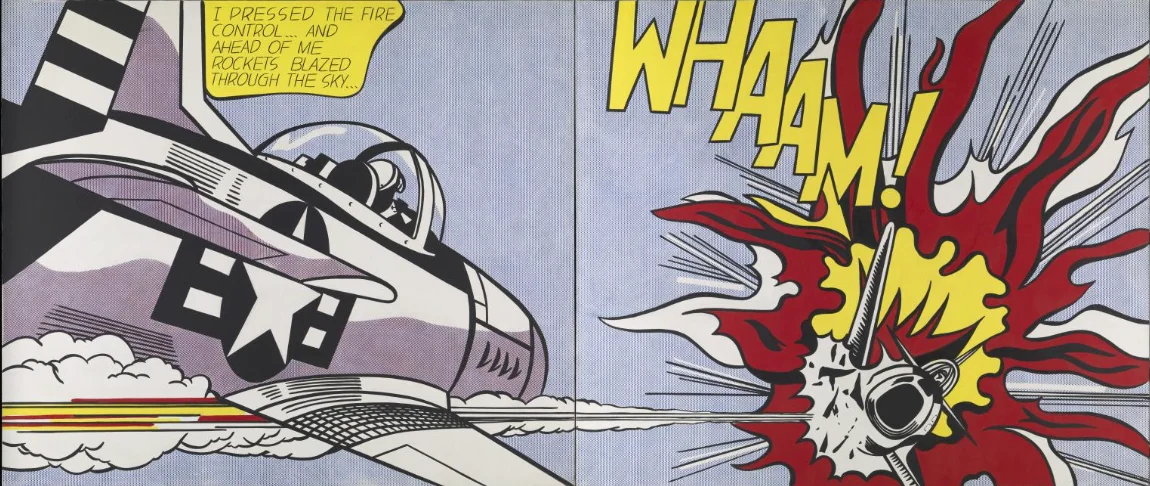
Whaam! 1963, Roy Lichtenstein. Whaam! is based on an image Lichtenstein found in a 1962 DC comic, All American Men of War. © Estate of Roy Lichtenstein
Lichtenstein is one of the defining figures of American Pop Art. His work took the visual codes of mass reproduction — comics, advertising, printed colour, mechanical dots — and enlarged them into paintings that look instantly familiar and strangely artificial.
Key Movements
Pop ArtA quick note
Roy Fox Lichtenstein was a leading figure of the Pop Art movement, best known for his large-scale paintings inspired by comic books, advertisements, and mass-produced imagery. His art is represented in major museum collections worldwide, and he remains one of the most influential and recognizable artists of the 20th century.
Emerging in the early 1960s, Lichtenstein gained international recognition for works that employed bold outlines, flat colors, and his signature use of Ben-Day dots—a mechanical printing technique he meticulously replicated by hand. Through this approach, he challenged traditional distinctions between "high" art and popular culture, transforming seemingly banal source material into monumental, self-aware compositions. His work often explored themes of romance, war, consumerism, and art itself, frequently incorporating irony and detachment to comment on modern visual culture.
Most Famous Artworks
- Whaam! — Tate, London
- Drowning Girl — MoMA, New York
- Look Mickey — National Gallery of Art, Washington, D.C.
- Girl with Ball — MoMA, New York
- Oh, Jeff…I Love You, Too…But… — private / major exhibition history
- Hopeless — Kunstmuseum Basel
- Brushstrokes — series
- Masterpiece — private collection
- In the Car — Scottish National Gallery of Modern Art
- Artist’s Studio “The Dance” — MoMA, New York
MoMA’s online collection includes major works such as Girl with Ball, Drowning Girl and Artist’s Studio “The Dance”.
Did you know?
In 2017, his painting Masterpiece (1962) sold privately in 2017 for around $165 million, making it one of the most expensive American artworks ever sold. What began as a provocative challenge to originality and “high art” has become a symbol of Pop Art’s lasting power—and its extraordinary appeal to top collectors.
The dots are not just decoration.
Lichtenstein’s famous Ben-Day dots imitate the cheap commercial printing process used in newspapers and comic books. By enlarging them on canvas, he made the mechanics of mass culture visible. What was supposed to disappear into the printed image became the star of the painting.
In other words: Lichtenstein made the “machine look” handmade.
Why are they important?
Beyond his comic-inspired paintings, Lichtenstein's wide-ranging career included sculpture, murals, prints, and reinterpretations of canonical works by artists such as Picasso, Monet, and Matisse. Lichtenstein feels more relevant than ever because we live inside image culture.Before memes, filters, reels and viral aesthetics, he was already exploring how reproduced images shape emotion. His women cry like cinema stills. His war scenes explode like advertisements. His brushstrokes look spontaneous, but are controlled and artificial.He asks a very contemporary question: When an image tells us what to feel, are we still feeling freely?
Roy Lichtenstein
- Born
- Died
- Nationality
- American
Artlovers Tip
On view now
Where to see them now
Plan your visit — these exhibitions are on view now.
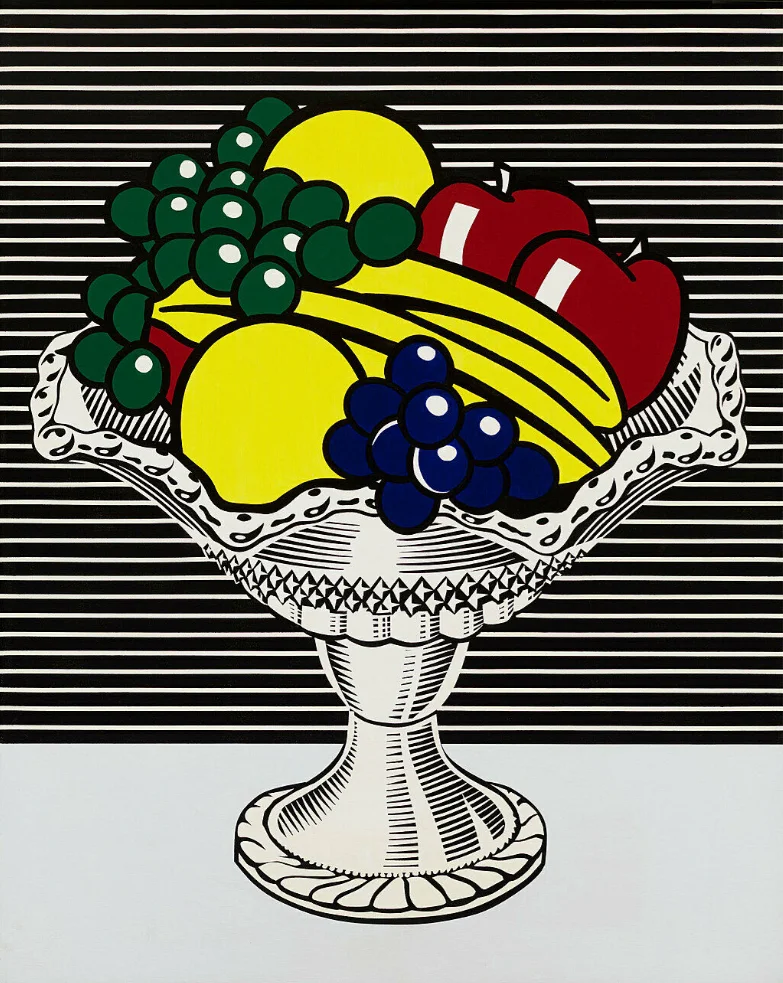
Roy Lichtenstein
Roy Lichtenstein made the language of comics, advertising and mass media impossible to ignore. Dots, speech bubbles, dramatic women, explosions, brushstrokes — he turned popular images into American art history.