A self-portrait that looks calm at first glance — until you notice that almost everything in it is hurting her.
Dates
Meet the artist

More details
- Original title
- Autorretrato con collar de espinas y colibrí
- Movement
- Surrealism
- Medium
- Oil Painting
- Genre
- Self-Portrait
- Dimensions
- 61.25 × 47 cm
The story behind it
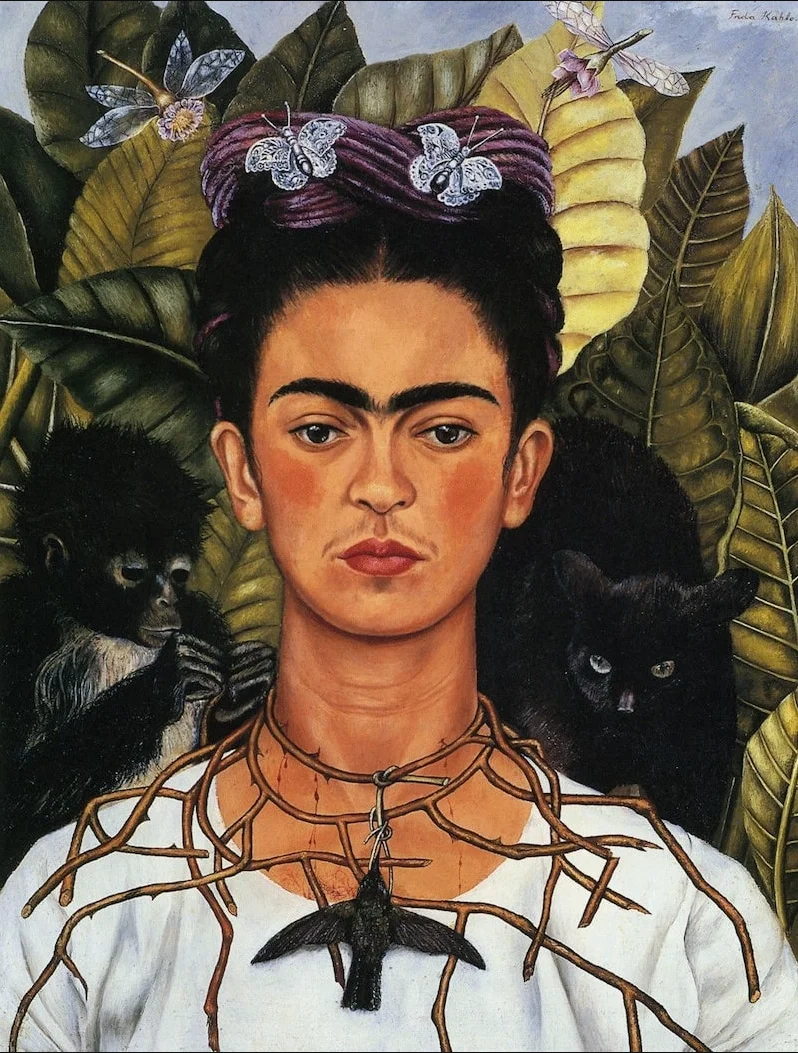
Frida Kahlo's Self-Portrait with Thorn Necklace and Hummingbird, painted in 1940, is a powerful exploration of pain, resilience, and identity. In this relatively small (24 x 18 inches) canvas, Kahlo confronts the viewer directly, her gaze unwavering. A thorn necklace, reminiscent of Christ's crown of thorns, digs into her neck, symbolizing the emotional wounds inflicted by her divorce from Diego Rivera and the end of an affair. A lifeless hummingbird hangs from the necklace, a potent symbol of lost love and vulnerability in Mexican folklore, contrasted by the lush, yet suffocating jungle scene surrounding her. The inclusion of a black cat (symbolizing bad luck) and a monkey (potentially representing Rivera) add layers of complexity to the narrative, hinting at the personal turmoil Kahlo was experiencing.
This self-portrait is historically significant because it reflects Kahlo's unique way of addressing her physical and emotional suffering through art. She reclaimed the traditionally male gaze by using her own body as the subject. By integrating Mexican cultural symbols and Tehuana clothing, Kahlo asserted her Mexican identity and challenged conventional notions of femininity. Her choice of clothing was inspired by Rivera's concept of Mexicanidad, a passionate identification with pre-Hispanic indigenous roots. The painting is currently housed in the Nickolas Muray collection at the Harry Ransom Center at the University of Texas at Austin, cementing its place in art history. Muray, who bought the portrait shortly after it was painted, played a significant role in preserving Kahlo's legacy.
Kahlo's artistic technique in this self-portrait is characterized by a deliberate blend of realism and symbolism. Her detailed rendering of her own features, down to her signature eyebrows, creates a striking sense of presence. The vibrant colors and dense composition draw the viewer into her emotional landscape. The contrasting imagery, like the dead hummingbird against the backdrop of lush foliage, adds depth and intrigue. Ultimately, Self-Portrait with Thorn Necklace and Hummingbird is a masterpiece because it is a deeply personal and unflinchingly honest expression of the artist's inner world, making it a relatable and moving work for viewers across cultures and generations.
Look closer
This is one of the most autobiographical paintings in art history.
Frida Kahlo spent much of her life in physical pain after a devastating bus accident when she was eighteen. But instead of hiding her suffering, she made it the subject of her art.
The hummingbird is especially intriguing. In Mexican tradition, it can symbolize love and good fortune. Here it appears dead, suggesting lost love and emotional devastation.
The painting also contributed to the myth of Frida Kahlo as a modern icon: vulnerable and strong, wounded and defiant at the same time.
Worth the journey?
Because few artists have ever been as honest as Frida Kahlo.
This portrait feels contemporary despite being painted in 1940. It speaks about identity, heartbreak, resilience, physical pain, and self-expression in a way that still resonates today.
Standing in front of it, you realize that Kahlo wasn't trying to paint how she looked.
She was painting how it felt to be Frida.
See it like an Artlover
1. Start with her eyes
They hold the painting together. Calm, direct, unflinching.
2. Then notice the thorns
What first looks decorative becomes painful.
3. Follow the symbols
The hummingbird, monkey, cat, butterflies — each carries meaning.
4. Move closer
Look at the tiny details of the leaves, blood, hair, and skin.
5. Step back again
The portrait transforms from a collection of symbols into a single emotional statement.
Self-Portrait with Thorn Necklace and Hummingbird
Hours & rating from Google