A double self-portrait that turns heartbreak into one of the most powerful images of identity in modern art.
Dates
Meet the artist
More details
- Original title
- Las dos Fridas
- Movement
- Mexican Muralism, Surrealism
- Medium
- Oil Painting
- Genre
- Self-Portrait
- Dimensions
- 173 × 173 cm
The story behind it
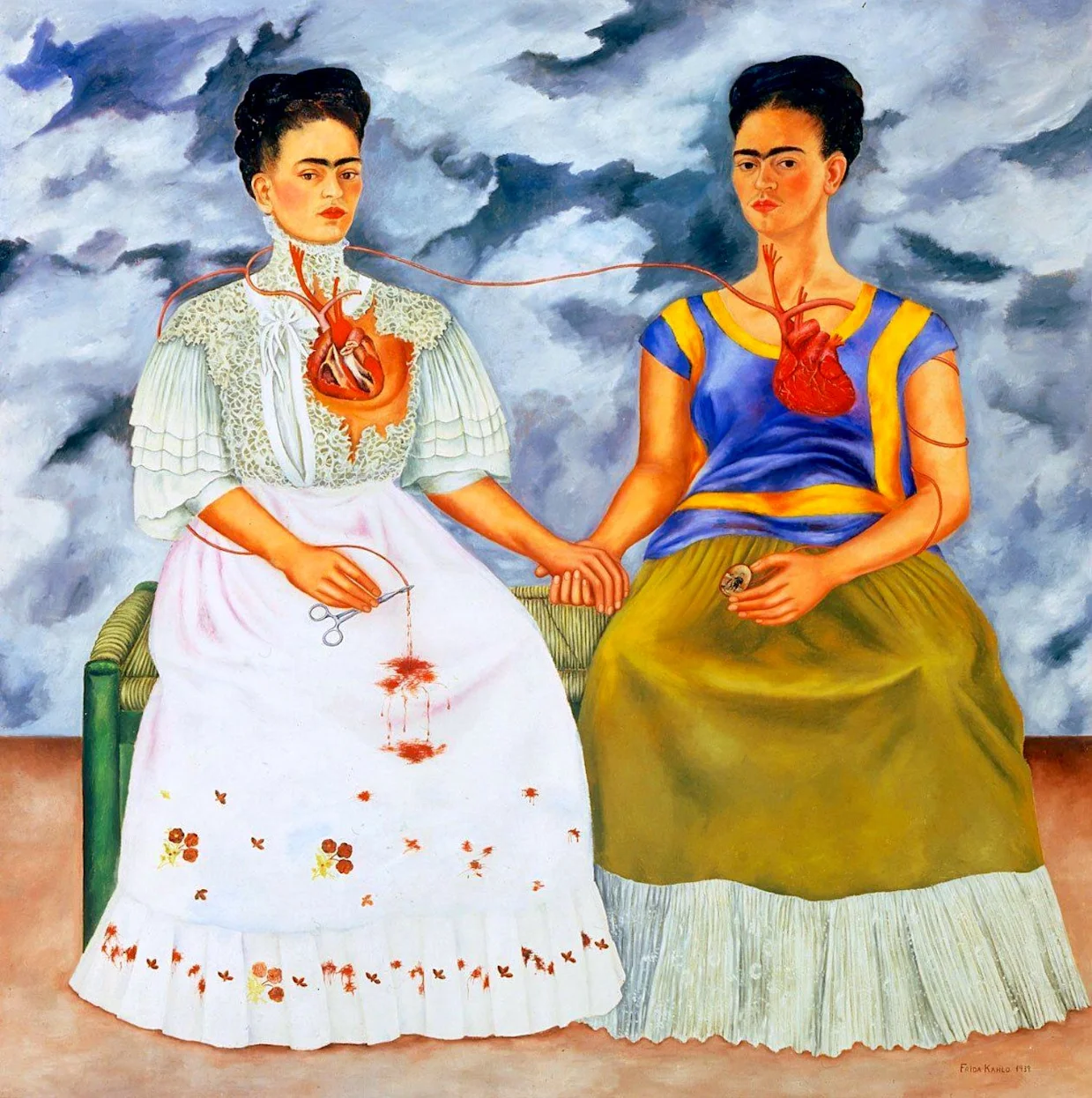
This is a powerful and deeply personal double self-portrait. It stands as Kahlo's first large-scale work and a cornerstone of her oeuvre. The painting portrays two versions of Frida seated side-by-side: one in a traditional Tehuana dress, symbolizing her Mexican heritage and Diego Rivera's love, and the other in a European-style Victorian dress, representing her European ancestry and perhaps the part of herself rejected by Rivera. The contrasting attire highlights Kahlo's exploration of identity and her complex relationship with her cultural background and personal life.
Kahlo's artistic technique in "The Two Fridas" is characterized by meticulous detail and a surreal, dreamlike quality. The figures are rendered with a sharp, almost photographic realism, while the background is a hazy, undefined space that adds to the painting's emotional intensity. The use of vibrant colors, particularly the red of the blood and the bright hues of the Tehuana dress, creates a striking visual contrast. The painting's impact extends beyond its artistic merit, serving as a symbol of Mexican identity, female empowerment, and the power of art to confront personal and societal challenges. Its influence can be seen in various cultural products, including the play "Las Dos Fridas," which further explores the multifaceted nature of Kahlo's identity.
Look closer
Frida painted The Two Fridas shortly after her divorce from Diego Rivera. Many interpretations see the two figures as different sides of her identity: the Frida loved by Diego and the Frida rejected by him. Kahlo once said she painted herself because she was the subject she knew best — transforming personal pain into universal symbolism.
Both Fridas display exposed hearts, revealing their emotional state. A single blood vessel connects the two figures, emphasizing their shared identity and the deep connection between them. The Tehuana Frida holds a miniature portrait of Rivera, while the European Frida clutches forceps that have severed the blood vessel leading to her, symbolizing the pain and loss she experienced after the divorce. The spilled blood on the white dress further emphasizes the emotional and physical suffering endured by Kahlo throughout her life. The painting's unflinching honesty and raw emotion resonate deeply with viewers, making it a poignant exploration of love, loss, identity, and pain.
Worth the journey?
Yes — absolutely worth the trip. Few paintings feel as emotionally direct and psychologically intimate. In person, the scale and detail make the exposed hearts and flowing blood deeply affecting. The work continues to resonate because it speaks about identity, duality, emotional pain, and resilience with extraordinary honesty.
See it like an Artlover
First observe the painting as a whole, then slowly follow the artery connecting both hearts. The emotional tension lives in that connection. Spend time comparing the expressions, clothing, and posture of each Frida — the contrasts reveal the psychological depth of the work.
The Two Fridas
Hours & rating from Google