A quiet field, a distant house, and one of the most haunting feelings of longing in American art.
Dates
The story behind it
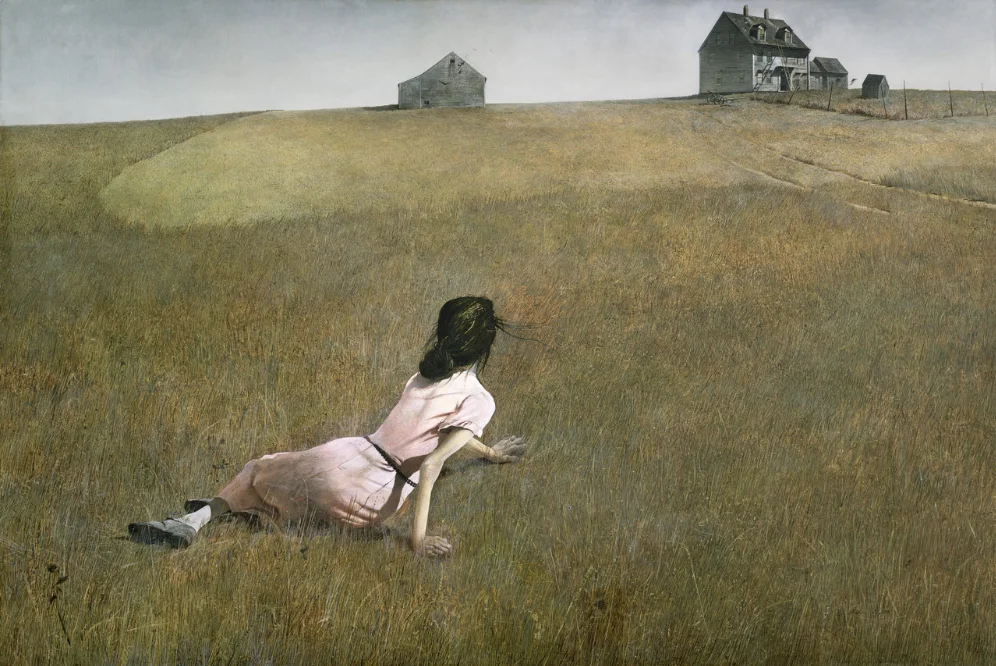
Andrew Wyeth's "Christina's World," painted in 1948, is an iconic and haunting image that captures a sense of isolation and yearning. The painting depicts a young woman, Christina Olson, lying in a field, seemingly unable to walk, as she gazes towards a distant farmhouse and barn. The landscape is rendered in muted earth tones, emphasizing the starkness and loneliness of the scene. The painting’s success is largely due to its enigmatic quality: viewers are left to wonder about Christina's condition, her relationship to the house, and the emotions conveyed by her posture and gaze.
Beyond its aesthetic appeal, "Christina's World" holds significant historical weight within the American art landscape. Created during a period of burgeoning Abstract Expressionism, Wyeth's precise realism and focus on rural American life set him apart. The painting became a symbol of American resilience and the enduring connection to the land, resonating with a public grappling with post-war anxieties and a rapidly changing society. Wyeth's meticulous attention to detail and his exploration of psychological depth within a seemingly simple scene secured the painting's place as a defining image of mid-20th century American art.
Wyeth's mastery of egg tempera contributes significantly to the painting's impact. This demanding technique, requiring careful layering and precise brushstrokes, allows for a remarkable level of detail and a subtle luminosity.
Look closer
The painting was inspired by Christina Olson, a neighbor of Wyeth in rural Maine who had a degenerative muscular condition and often moved across the ground using her arms rather than a wheelchair.
Wyeth transforms a personal observation into a universal image of determination, distance, and solitude.
Worth the journey?
Yes — absolutely worth the trip. Few paintings communicate emotion through silence so effectively. In person, the textures, muted colors, and open space create an atmosphere that feels deeply cinematic and psychological. The work continues to resonate because it leaves so much unsaid, allowing viewers to project their own feelings into the scene.
The painting matters because it encapsulates universal themes of longing, disability, and the complex relationship between humans and their environment, continuing to inspire and provoke discussion today.
See it like an Artlover
Spend a moment focusing first on the landscape rather than Christina herself. The emotional weight of the painting comes from the enormous distance between the figure and the house. Then slowly return to her posture and realize how much effort and determination the scene contains. This is a work that invites contemplation and personal interpretation.
Artlovers Tip:
Don’t rush to interpret the painting as sadness alone. There’s also resilience and persistence in Christina’s pose. The longer you look, the more the empty field begins to feel psychological rather than physical — like a space between desire and reality.
Christina’s World
Hours & rating from Google