At a glance
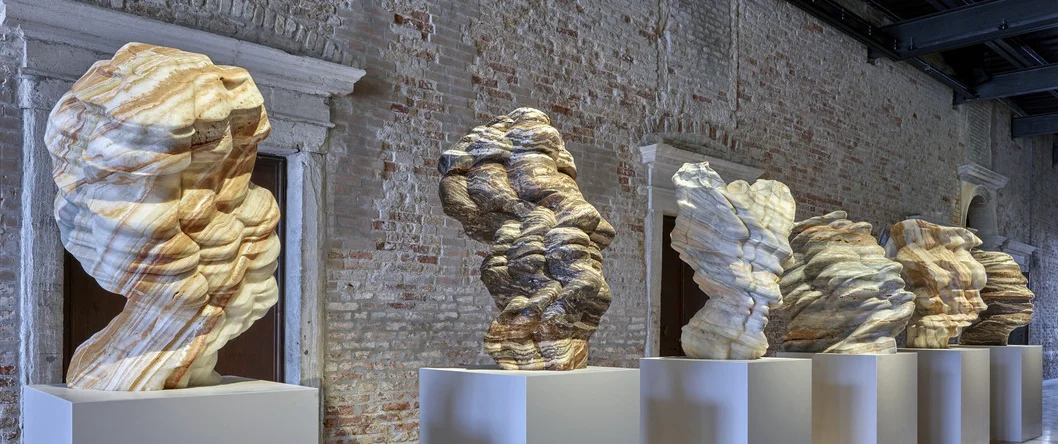
Wood and stone seem to twist, grow and move as Tony Cragg pushes sculpture toward forms that feel almost alive.
Why go
You'll see
Pace of visit
Don't miss

Artlovers Tip
Move around them. A Tony Cragg sculpture rarely has a single privileged viewpoint. The reward comes when an apparently abstract mass suddenly suggests a face or body — and then disappears again after another two steps.
Inside the exhibition
Meet the artist
Key Movements
Medium
Period
Description
New Works presents a selection of Tony Cragg’s recent sculptures in wood and stone, concentrating on his continuing investigation into material, structure and movement. Organic-looking forms can suggest waves, plants, geological formations or cellular processes, but Cragg is not trying to imitate nature. Instead, he searches for new sculptural structures that reveal possibilities already latent within matter.
The exhibition is particularly appropriate at Waldfrieden. Cragg founded the sculpture park in Wuppertal, where architecture, woodland and sculpture are deliberately brought together. Here his forms can be experienced from multiple viewpoints and against constantly changing natural surroundings.
Tony Cragg (b. 1949, Liverpool) is one of the most important British sculptors of his generation. After studying at the Royal College of Art, he moved to Germany, where he has lived and worked for decades.
His early practice often involved found and industrial materials, but his sculpture progressively evolved toward increasingly complex investigations of volume, surface, movement and material. Wood, stone, bronze, steel and glass can appear to stretch, rotate or mutate into forms somewhere between the geological, biological and entirely invented.
Cragg represented Britain at the Venice Biennale in 1988 and won the Turner Prize the same year.
Worth travelling for?
Waldfrieden is arguably one of the best places in the world to experience Tony Cragg. This isn't simply a temporary exhibition inside a museum: Cragg created the sculpture park itself, and seeing his newest works surrounded by woodland makes the relationship between matter, movement and nature much easier to understand.