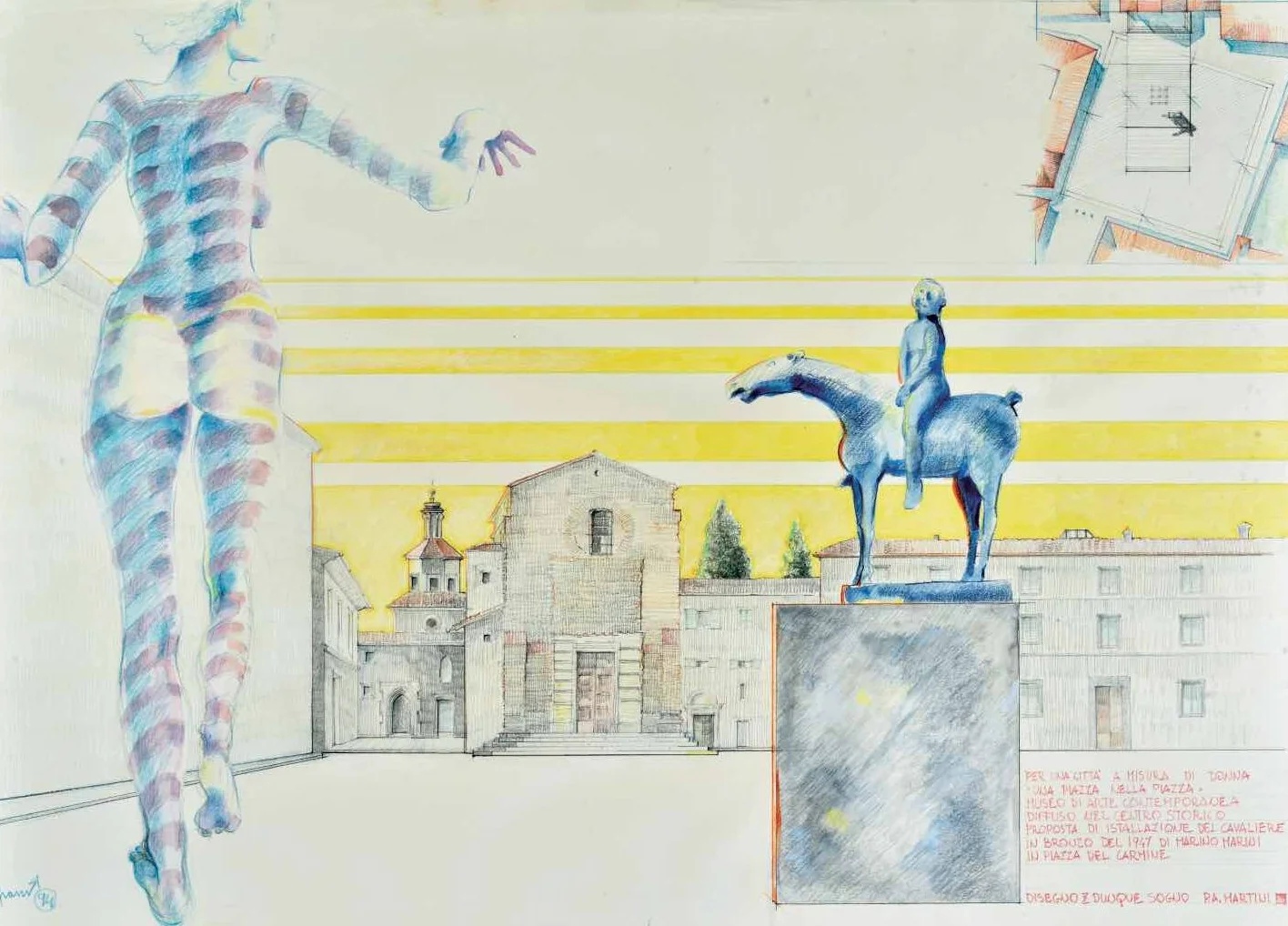
For Paolo Antonio Martini, drawing was where architecture became imagination — fifty years of sketchbooks reveal a restless mind constantly turning observation into ideas.

Look at the drawings as a form of thinking rather than preparation for architecture. For Martini, drawing was simultaneously observation, design, storytelling and dreaming.
Artlovers mood: Curious · Intimate · Imaginative · Architectural
Inside the exhibition
Paolo Antonio Martini. Disegno e dunque sogno is on view in the Sale Fabiani of Palazzo Medici Riccardi, Florence, from 28 May to 13 September 2026. Organised by Fondazione MUS.E, it is curated by Samuele Caciagli and Francesco Gurrieri, from a project by Laurence Morel, Charlotte Martini and Sibylle Martini.
Martini — often known simply by his initials PAM — was born in Massa in 1943 and died in Florence in 2022. Architect, illustrator and draughtsman, he described himself with the hybrid idea of an “archi-sta”, reflecting a practice in which architectural discipline and artistic freedom continually overlapped.
The exhibition takes its title from one of his favourite expressions, Disegno e dunque sogno — approximately, “I draw, therefore I dream.” It captures his belief that drawing was not merely a way to represent a finished idea but a means of discovering one.
Its core is a selection from the extraordinary archive of more than 100 notebooks spanning 1972–2022. Sketches sit beside annotations, watercolours, architectural studies, illustrations, comics and imaginary characters. Together they reveal a creative process in which the boundaries between architecture, art and narrative become deliberately porous.
Martini also left a visible mark on Florence as an architect. His projects included the Parterre piazza-parking system in Piazza della Libertà and the restoration of the former Paradiso degli Alberti convent.
Worth travelling for?
★★★½ — Worth the stop, especially for architecture and drawing lovers.
Not a blockbuster, but a rewarding discovery. Its charm lies in getting unusually close to the creative process itself: the moment before architecture becomes a building, when it still exists as a line, an observation or an idea in a notebook.