At a glance
Ritual, identity and everyday life become poetic symbols in Graciela Iturbide’s extraordinary black-and-white vision of Mexico and beyond.
Why go
You'll see
Pace of visit
Don't miss

Artlovers Tip
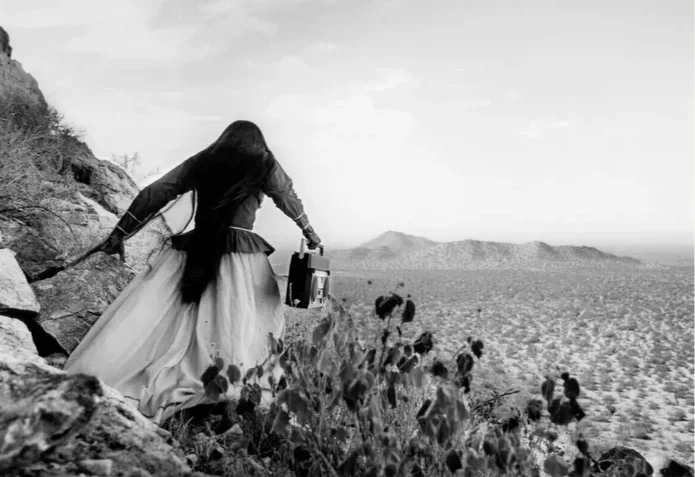
Don’t read the photographs only as documents of Mexico. Iturbide is strongest when reality starts to become metaphor: an iguana turns into a crown, birds become omens, and an ordinary landscape begins to feel almost mythological.
And look at the contact sheets. They reveal something a famous single photograph cannot: how Iturbide searched, waited and chose the precise image that became iconic.
Artlovers relevance
Inside the exhibition
Meet the artist
Key Movements
Medium
Genre
Description
Eyes to Fly With surveys more than half a century of Iturbide’s photography through recurring themes of identity, gender, community, ritual, spirituality and mortality. Her celebrated photographs of the Zapotec women of Juchitán complicate conventional gender narratives by foregrounding women’s social and economic authority, while other series examine migration, sacrifice, Indigenous communities and the persistence of everyday rituals.
The exhibition also expands the familiar picture of Iturbide. Alongside iconic black-and-white photographs are rarely exhibited vintage prints, colour work and contact sheets, revealing how she edits, observes and constructs photographic sequences. Developed closely with the artist and originally organised by C/O Berlin, the retrospective is curated by Sophia Greiff and Melissa Harris.
Graciela Iturbide (b. 1942, Mexico City) is one of the most important Latin American photographers of the past fifty years. Her work grows from documentary observation but repeatedly moves toward something more symbolic and poetic, where birds, landscapes, rituals and bodies can carry several meanings at once.
Rather than treating photography as objective evidence, Iturbide sees it as a way of exploring both the external world and herself — an idea reflected in the exhibition title, inspired by one of her self-portraits.