At a glance
Basquiat confronts Italy’s artistic past, turning emperors, Renaissance masters and inherited symbols of power into an urgent contemporary language.
Why go
You'll see
Neo-Expressionism · Graffiti art · Neo-Pop · Contemporary figurative painting · Downtown New York
- More than 60 paintings and works from major international collections
- References to ancient Rome, Renaissance art and Leonardo da Vinci
- Anatomical figures, crowns, pictograms and fragmented words
- Works connecting historical authority with contemporary race and inequality
- Evidence of Basquiat’s exhibitions and working periods in Modena, Rome and Florence
- Street imagery colliding with centuries of European visual culture
Pace of visit
This is expected to be a dense exhibition. Basquiat’s paintings demand time because words, crossed-out phrases, anatomical diagrams and historical references operate simultaneously.
Don't miss
The Italian connections: Follow Basquiat’s relationship with Modena, Rome and Florence rather than viewing Italy as a decorative exhibition theme.
References to Leonardo: Look for anatomical structures and notebook-like combinations of image, diagram and text.
Symbols of authority: Crowns, classical figures and celebrated historical names may appear affirmative, ironic or accusatory—often all three at once.
The crossed-out words: Basquiat said that obscuring a word could make viewers want to read it more intensely.
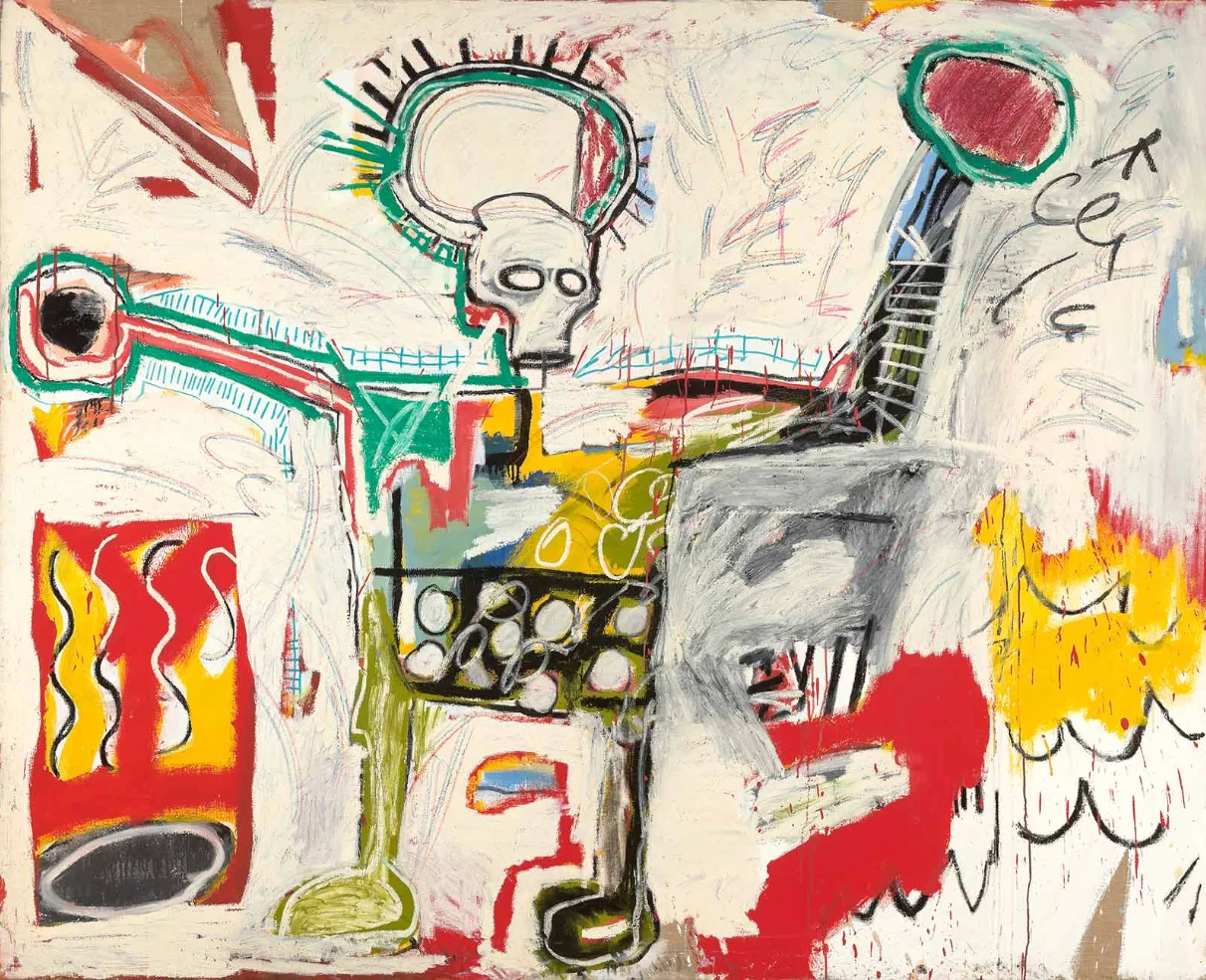
Untitled, 1982: The work from Museum Boijmans Van Beuningen chosen as the exhibition’s principal image condenses bodies, marks and historical fragments into an unstable human presence.

Artlovers Tip
Treat Basquiat’s paintings as pages to be decoded, but do not try to solve everything.
Basquiat exhibitions are often built around biography, celebrity and the mythology of downtown New York. This one promises something more distinctive: an examination of how a young Black artist entered into a fierce, irreverent dialogue with European art history.
With more than 60 international loans, this could become one of Europe’s major Basquiat exhibitions of the decade.
Inside the exhibition
Meet the artist

Description
Basquiat. In Italian explores Jean-Michel Basquiat’s engagement with Italy and with the broader history of Western art. Curated by Dieter Buchhart and Anna Karina Hofbauer, it brings together more than 60 works from important public and private collections.
The exhibition connects Basquiat’s figures and symbols with sources extending from ancient Egypt and Rome to Leonardo da Vinci, Galileo Galilei and Renaissance culture. These references were never passive tributes. Basquiat sampled, fractured and recombined history, questioning who receives recognition and whose stories are erased.
Italy also played a direct role in his career. Basquiat travelled to Modena in 1981 for his first European solo exhibition at Galleria Emilio Mazzoli. He returned the following year, producing the celebrated group now known as the Modena Paintings and participating in Transavanguardia: Italia/America. Further visits took him to Rome and Florence.
Palazzo Strozzi provides more than a prestigious setting. Its Renaissance architecture places Basquiat’s art inside the cultural tradition he repeatedly admired, borrowed from and challenged. The encounter should make his paintings appear not outside art history, but actively rewriting it.
About Jean-Michel Basquiat
Jean-Michel Basquiat was born in Brooklyn in 1960 to a Haitian father and a Puerto Rican mother. As a teenager, he attracted attention through poetic and cryptic messages written around Lower Manhattan under the name SAMO, initially developed with Al Diaz.
By the early 1980s, he had moved from the street into galleries, creating paintings that fused anatomy, jazz, boxing, advertising, comics, African diasporic history and European art. Words, diagrams and symbols collide across his surfaces, forming images that feel improvised but are intellectually precise.
Basquiat used historical knowledge to examine racial identity, colonialism, exploitation and cultural authority. His recurring crown can signify achievement, self-coronation, fame or the burden placed upon celebrated Black figures.
He died in 1988 at only 27. Despite a career lasting less than a decade, he transformed contemporary painting and remains one of the most influential—and commercially powerful—artists of the late twentieth century.
Basquiat. In Italian
Artlovers relevance
Plan your visit
Hours & rating from Google