Max Beckmann painted the 20th century as if it were a theatre of crisis: masks, mirrors, exile, violence, crowded rooms, and people who seem trapped inside history.
Key Movements
Expressionism, Figurative Expressionism, ModernismA quick note
German Expressionism · New Objectivity · Modernism
Beckmann is often connected to Expressionism, but he resisted labels. His work is darker, more theatrical and more psychologically complex than simple categorisation allows.
Looking at Beckmann means entering a world under pressure.
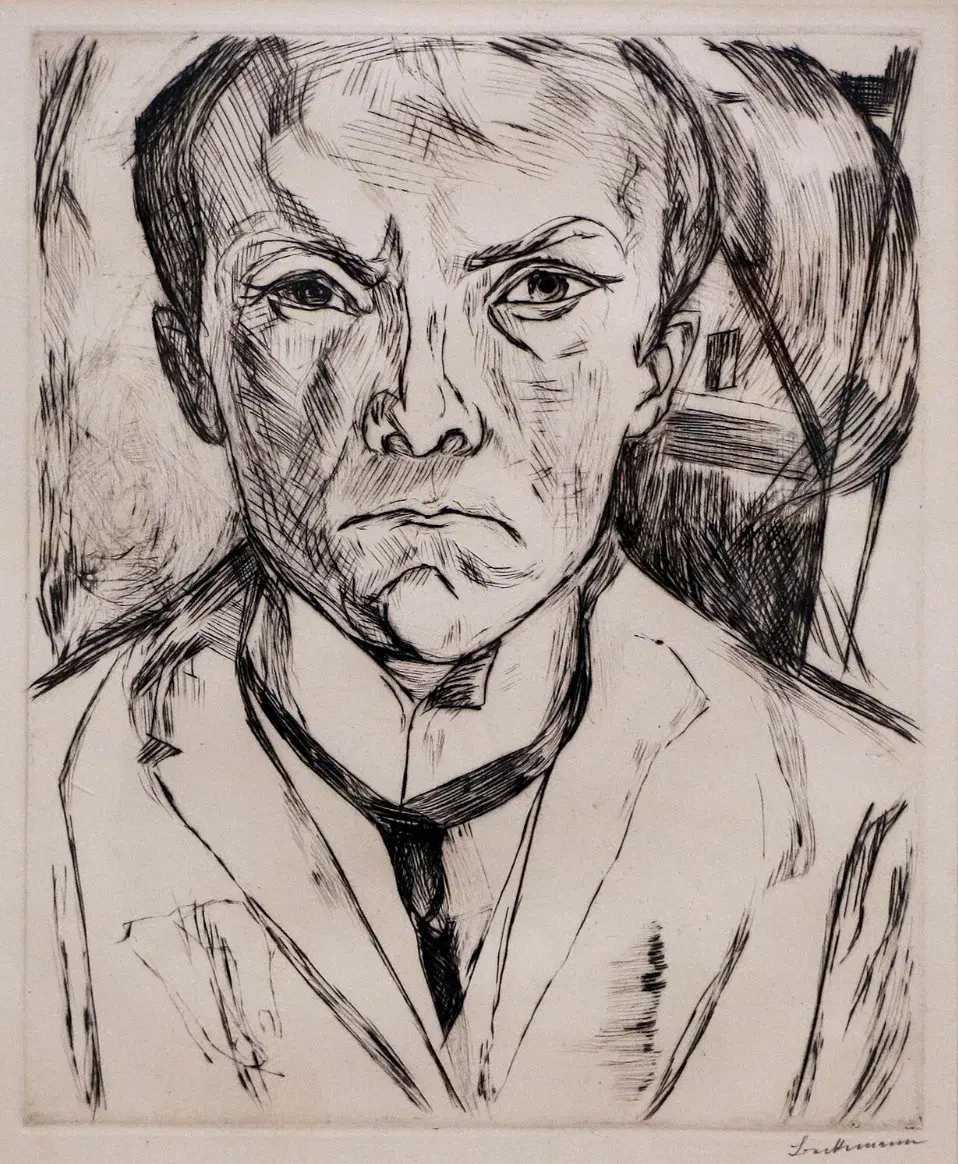
His paintings are full of compressed spaces, heavy outlines, sharp angles, strange costumes, performers, sailors, cabaret figures, mythological references and self-portraits that feel like confrontations. The figures often seem boxed in, as if the canvas itself were too small for the violence, anxiety and drama inside it.
Beckmann’s art is not decorative suffering. It is a visual language for a world breaking apart: war, exile, modern life, moral collapse, identity, survival. His rooms feel like stages, but nobody is fully acting. Everyone seems exposed.
His famous triptychs are especially powerful: large, cinematic structures where myth, politics and personal experience collide.
Did you know?
In 1937, the Nazis included several of his works in the infamous “Degenerate Art” exhibition. The day after its opening, Beckmann left Germany for Amsterdam with his wife, Quappi. He never returned to live in Germany.
The irony is huge: the regime tried to humiliate modern artists, but today Beckmann is considered one of the essential painters of the 20th century.
Why are they important?
Beckmann feels very relevant now because his work speaks to crisis without simplifying it. He does not offer comfort. He shows a world of instability, displacement and psychological tension — themes that still feel painfully contemporary.Beckmann is an artist to see in person because the pressure of his compositions, the density of the figures and the darkness of his colour cannot be fully felt on a screen.He is particularly worth seeking out in major collections in Germany, Switzerland, New York and St. Louis, where key works and triptychs reveal the full force of his vision.
Max Beckmann
- Born
- Died
Artlovers Tip
With Beckmann, stay with the discomfort. His paintings are not meant to be pleasant; they are meant to make you feel the tension of being human in a dangerous century. Do not try to “understand” everything at once. Beckmann’s paintings are built like psychological puzzles. Start with the space: notice how crowded and compressed it feels. Then look at the faces, hands, costumes and objects. Ask yourself: who is performing, who is trapped, and who is watching?