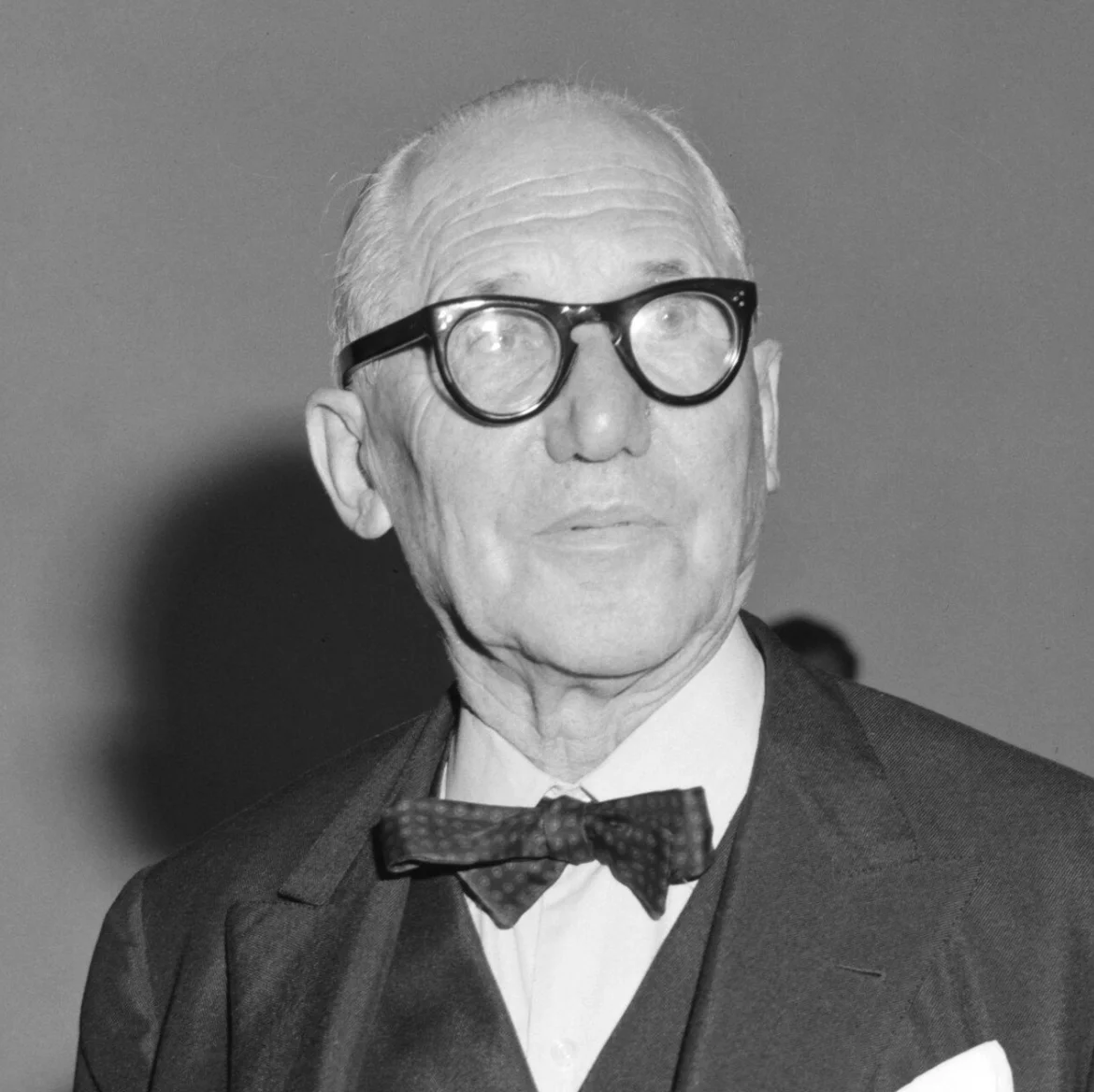
Le Corbusier did not just design buildings. He redesigned the idea of modern life: light, concrete, geometry, cities, furniture, and the dream — sometimes controversial — of a new way to live.
Key Movements
Architecture, ModernismA quick note
Charles-Édouard Jeanneret, known as Le Corbusier, was a French-Swiss architectural designer, painter, urban planner and writer who was one of the pioneers of what is now regarded as modern architecture. He was also connected to International Style, Purism, Brutalism, urban planning, functionalism, and modern architecture.
Looking at Le Corbusier means watching architecture become a manifesto. His buildings often use clean volumes, pilotis, flat roofs, open plans, horizontal windows, ramps, concrete, and strong geometric forms.
But his work is not only cold rationalism. In places like Villa Savoye, Ronchamp Chapel, or Unité d’Habitation, you see a search for a new relationship between body, space, light, and society. He wanted architecture to shape how people live, move, rest, gather, and dream.
Le Corbusier’s work can feel minimal, radical, spiritual, severe, or utopian — sometimes all at once.
Did you know?
Le Corbusier loved order, geometry, and “machines for living”… but his own private life was full of contradictions.
He also had a complicated reputation: visionary, arrogant, brilliant, controlling. Many admired him as a genius; others saw him as someone who wanted to redesign people’s lives a little too much.He promoted rational, functional living, yet he became almost obsessed with the tiny cabin he built for himself in Roquebrune-Cap-Martin, the Cabanon: a very small wooden retreat of about 3.66 × 3.66 metres.
So the man who imagined entire modern cities ended up finding peace in something almost anti-monumental: a miniature room by the sea.
Le Corbusier wanted to build the future — but his happiest place may have been a tiny cabin facing the Mediterranean.
Why are they important?
Le Corbusier is still relevant because we are still living inside many of his questions: What should cities be? How much standardisation do we want? Can design improve daily life? When does utopia become control?His legacy is powerful and controversial. He changed architecture forever, but his urban ideas also raise debates about scale, social housing, human warmth, and the risks of designing life from above.Seeing a Le Corbusier building in person is not about decoration. It is about feeling space, proportion, light, and the ambition of the 20th century.
Le Corbusier
- Born
- Died
- Nationality
- French, Swiss