At a glance
From Cornish coastlines and Alpine glaciers to radiant late abstractions: eight decades of an artist who never stopped finding new energy in colour.
Key Movements
Medium
Why go
You'll see
This is a dense retrospective with more than 170 works and archival material. Allow two hours to follow the evolution from observation-based landscapes to increasingly independent abstraction; around 75–90 minutes is sufficient for a more selective visit.
Don't miss
- The glacier paintings
- The Scorpio series

Artlovers Tip
Barns-Graham has often appeared as a supporting figure in histories dominated by Barbara Hepworth, Ben Nicholson and other members of the St Ives circle. This exhibition finally gives her eight-decade career the space it deserves.
Inside the exhibition
Meet the artist
Description
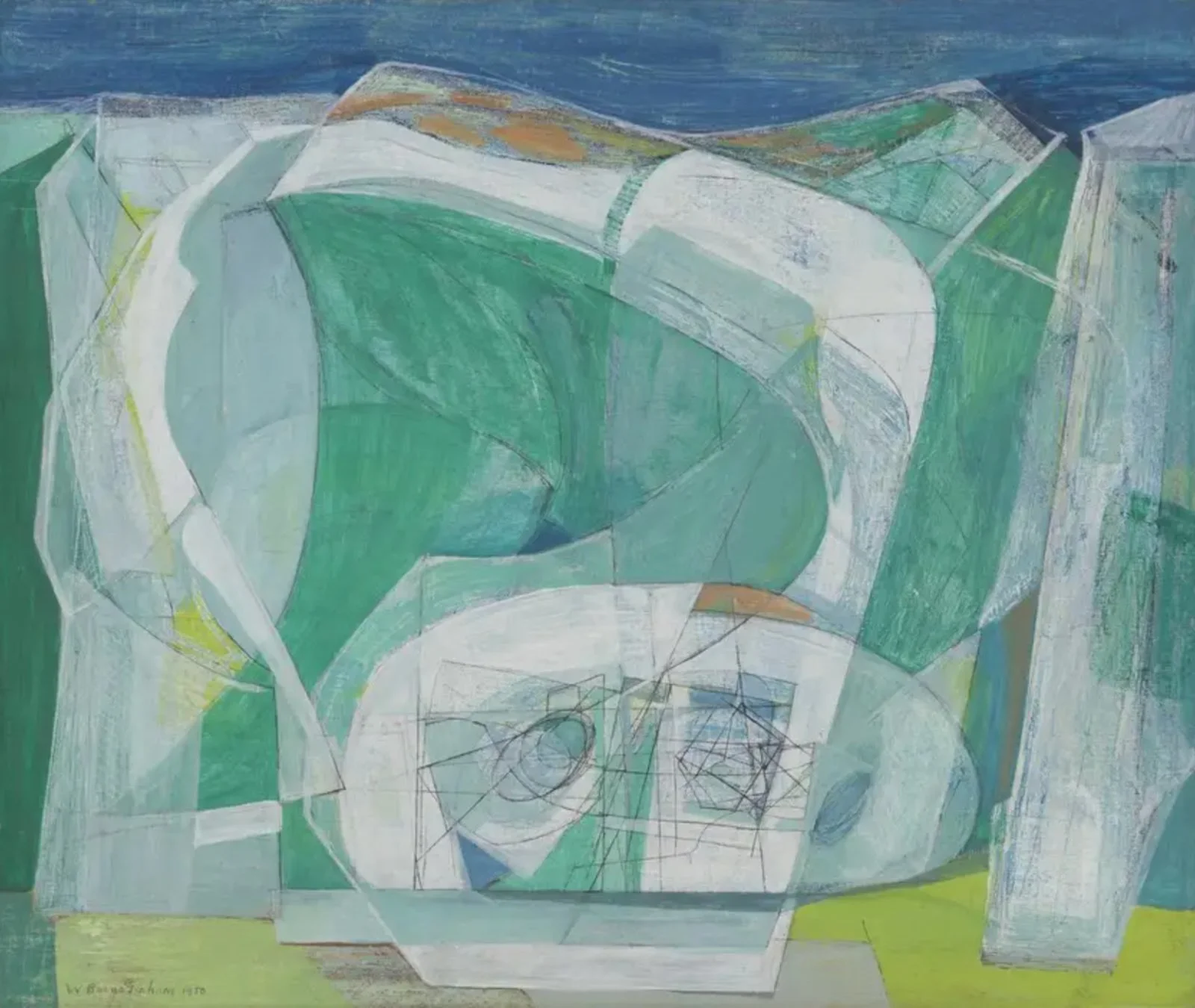
This major Tate St Ives retrospective follows Wilhelmina Barns-Graham’s practice across eight decades, from her training at Edinburgh College of Art and arrival in Cornwall in 1940 to her final, exuberant abstractions.
The exhibition brings together more than 170 paintings, works on paper, prints and archival objects. Early landscapes and interiors reveal how she learned to reduce observed places into structural relationships. Her glacier paintings transform ice, water and geological pressure into translucent, intersecting planes, while later works explore natural movement through increasingly abstract combinations of colour, line and rhythm.
Travels to Orkney, Switzerland and Lanzarote expanded her visual vocabulary, but Cornwall and Scotland remained her two principal creative territories. The final galleries focus on the expressive paintings and innovative screenprints of her later life, culminating in the Scorpio series.
Together, they challenge any idea that her career can be understood simply as a transition from landscape to abstraction: throughout her life, she used abstraction as another way of looking more intensely at the world.
Wilhelmina Barns-Graham (1912–2004) was a Scottish-born British artist and an important figure in postwar abstraction. She studied at Edinburgh College of Art before moving to St Ives in 1940, where she joined a modernist community that included Barbara Hepworth, Ben Nicholson and Patrick Heron.
Wilhelmina Barns-Graham
Artlovers relevance
Plan your visit
Tate St Ives — Cornwall
St Ives, United Kingdom