At a glance
Oscar Murillo reimagines Monet’s fading sight as a shared social space, inviting visitors to leave their own marks on canvas.

Artlovers Tip
Inside the exhibition
Meet the artist
Description
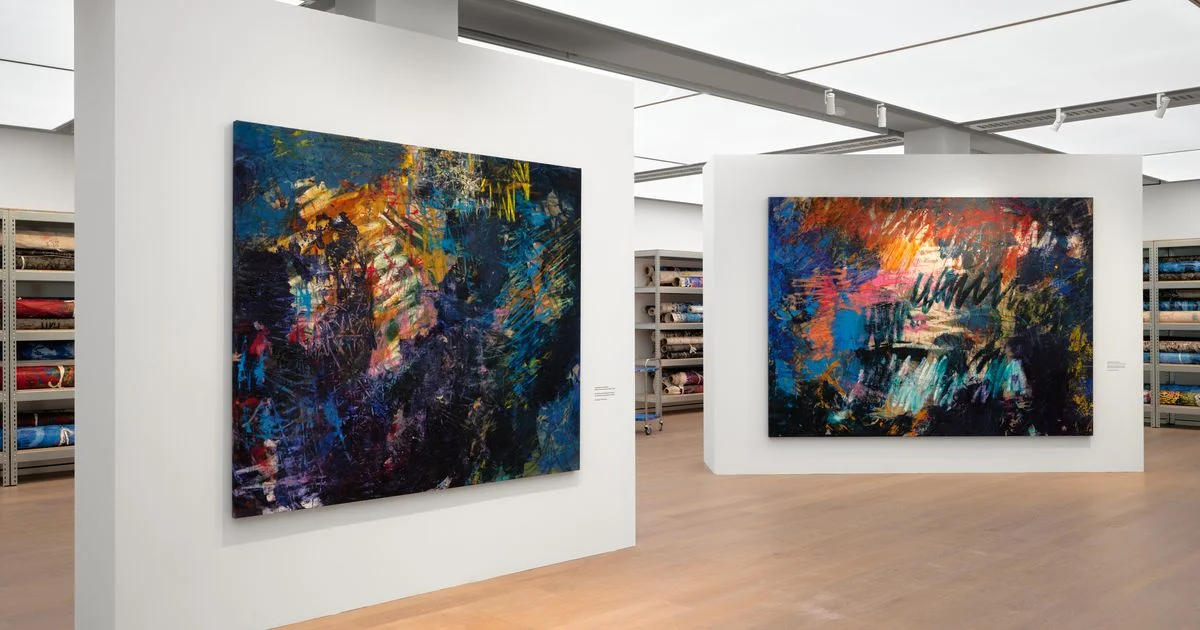
At DAS MINSK, Oscar Murillo treats the museum as a living organism rather than a silent vault. Drawing from the science of osmosis, the Colombian-born artist creates a dialogue with Claude Monet, specifically focusing on how the French painter’s late-life cataracts altered his perception of light and form. For Murillo, these hazy, abstract shifts are metaphors for the blind spots in our own society, prompting a deeper investigation into what it means to truly see one another.
You're watching a collision of temporalities where deep blue pigments meet the raw textures of participatory canvases. Large-scale works stretch across the gallery and onto the outdoor terrace, inviting your own hand to join the composition. The atmosphere is one of porous boundaries, where the quiet introspection of Monet's water lilies finds a vital partner in Murillo's thick, rhythmic strokes and the collected markings of school children from around the world.
Worth travelling for?
- A dual-venue dialogue: The exhibition spans both DAS MINSK and Museum Barberini, marking a rare collaboration that places Murillo’s contemporary abstractions alongside Monet’s iconic grainstacks and water lilies.
- Living canvases: Unlike traditional exhibitions, you are invited to participate in a collective painting process on the museum terrace, contributing your own marks to a nationwide social mapping project.
- Global school voices: The show features the Frequencies project, displaying canvases that lived on school desks for months to capture the unfiltered thoughts and doodles of children from the region.
Experience as an Artlover
Spend the morning at DAS MINSK before taking the short walk to Museum Barberini to complete the circuit. Carry the Perpetual Blue podcast in your ears as you cross Potsdam; it bridges the gap between the two sites with reflections on the historical weight of pigments. Afterward, walk through the nearby gardens to see how the changing light reflects off the water, much like the impressions captured in the galleries you’ve just left.