At a glance
Verena Paravel transforms the invisible vibrations of the Rhône delta into a monumental sensory map of the living world.

Artlovers Tip
Look closely for the scientists appearing in the film; they are treated as just another part of the ecosystem, filmed with the same clinical yet poetic lens as the plants and silt.
Inside the exhibition
Meet the artist
Description
Verena Paravel, a filmmaker who weaves together anthropology and art, turns her attention to the wetlands of the Camargue. This commission stems from her Cosmofonia project, an investigation that shifts the focus from sight to sound, exploring frequencies that typically fall outside human reach. By capturing the subtle clicks of crustaceans and the seismic pulse of the earth, Paravel invites us to understand the environment not as a static backdrop, but as a vibrant mesh of relations in constant flux.
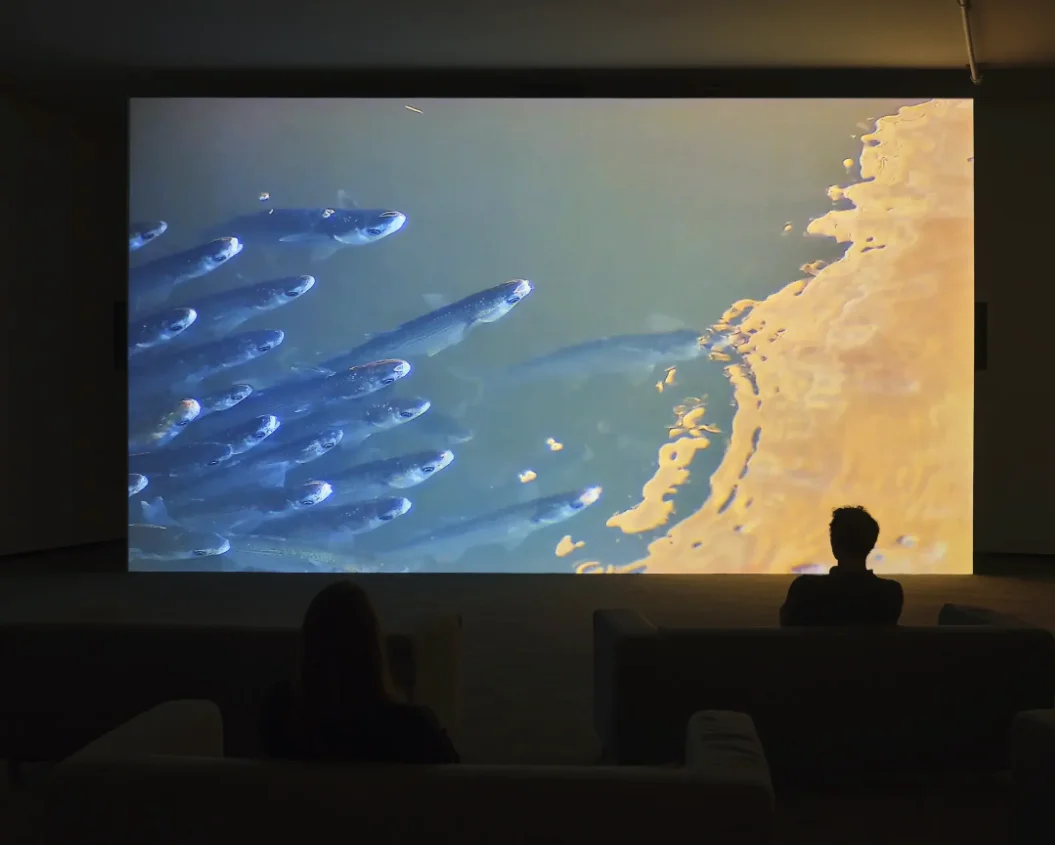
You're watching a towering eight-meter projection that transforms the gallery into a threshold to the delta. Wrapped in an immersive soundscape, you perceive the rustle of reeds and underwater signals with near-physical clarity. There are no hierarchies in this image; the camera treats a migratory bird and the river silt with the same delicate weight, urging us to lose our sense of human centrality within the natural world.
Worth travelling for?
- Site-specific resonance: Experience a film commissioned specifically for Arles, capturing the hidden acoustic life of the surrounding Rhône delta.
- Beyond human hearing: Encounter seismic vibrations and interspecies signals made audible through advanced scientific recording technology.
- Immersive scale: Stand before a monumental eight-meter projection that places the viewer inside the porous boundaries of land and water.
Experience as an Artlover
Enter the gallery slowly and allow your ears to adjust before your eyes; the piece relies on a point of hearing to guide the visual experience. Spend time standing at different distances from the eight-meter screen to feel the shift in physical presence. After leaving the Tower, take a drive south toward the salt flats of the Camargue to see—and now hear—the landscape with a newly attuned sensitivity.