Dates
Meet the artist
More details
- Original title
- L'Origine du monde
- Movement
- Realism
- Medium
- Oil Painting
- Genre
- Nude
- Dimensions
- 46 × 55 cm
The story behind it
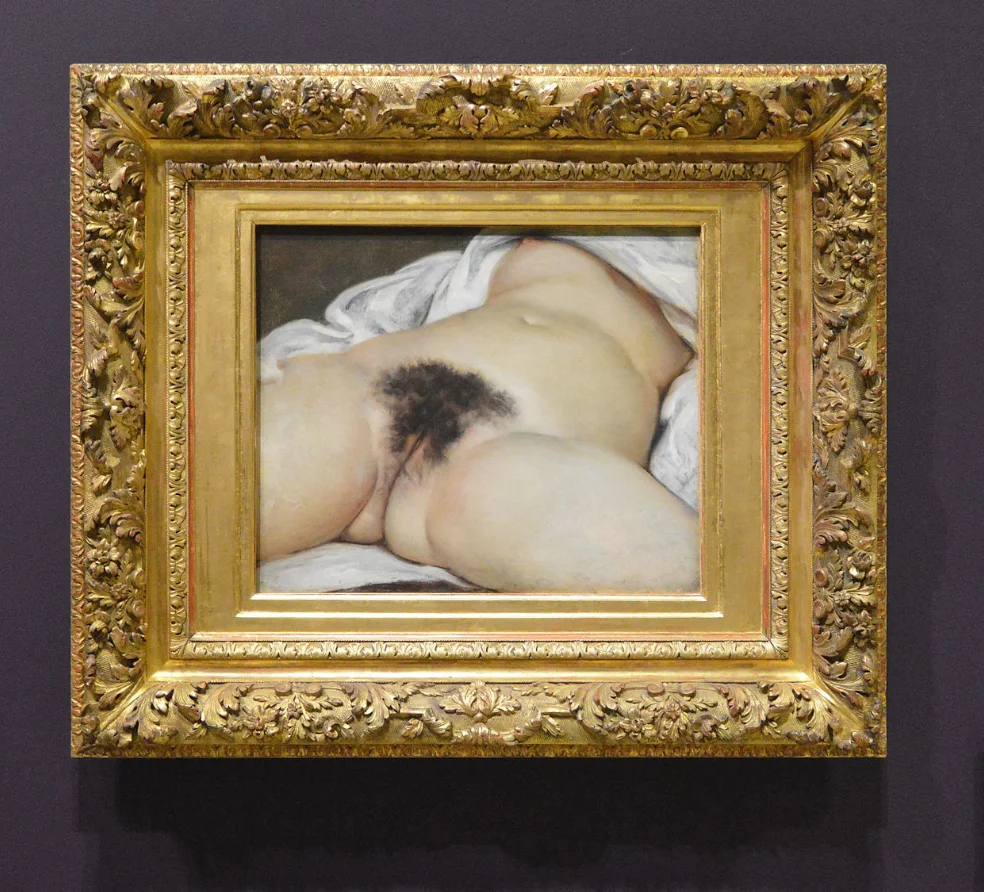
Painted by Gustave Courbet in 1866, L’Origine du monde is one of the most controversial artworks in Western art history—and still feels surprisingly modern.
It’s a radically cropped, hyper-realistic depiction of a woman’s body—no face, no identity, no narrative.
- No mythological excuse (like Venus or nymphs)
- No idealization
- No symbolism to “soften” it
It is a close-up view of the vulva and abdomen of a naked woman, lying on a bed with legs spread.
That’s what made it so shocking: Courbet stripped away every traditional justification for nudity in art.
Why it was so scandalous
In the 19th century, nudity in painting was allowed—but only if: it was mythological,
religious or “elevated” in some way
Courbet ignored all of that.
A secret life (for over 100 years)
Commissioned by an Ottoman diplomat (with a taste for erotic art)
Kept hidden in private collections
Sometimes covered by another painting (literally concealed behind a panel)
Not publicly shown until the late 20th century
Why it matters today
Now in the Musée d'Orsay, the painting is still debated:
Is it liberating realism or objectification? Is it about truth or provocation?
What’s undeniable:
Courbet pushed realism to its absolute limit
He forced art to confront what it usually hides
Look closer
The Artlovers way to see it: Instead of asking “is this too much?”, try:
Why remove the face? → anonymity or universality?
Why this title? → biology as the ultimate origin story
Why does it still feel uncomfortable today?
Because the painting isn’t just about a body.
It’s about where life begins—and how society chooses to look (or not look) at it.
The Origin of the World
Hours & rating from Google