The painting that scandalized Paris and changed modern art forever with a single unapologetic gaze.
Dates
The story behind it
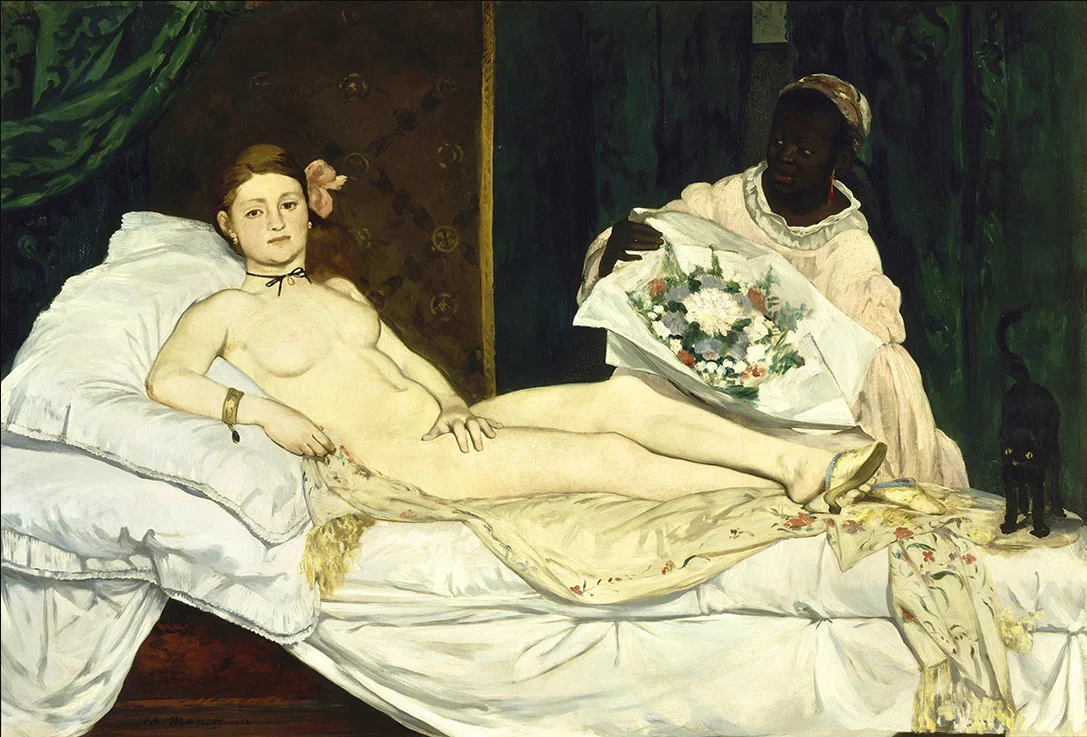
Édouard Manet's "Olympia," painted in 1863, is a groundbreaking work that redefined the art world's perception of the female nude. The painting depicts a nude woman, Olympia, reclining on a bed, attended by a black servant offering her flowers. Unlike idealized nudes of classical mythology, Olympia is a modern woman, a courtesan, whose gaze is direct and unapologetic, confronting the viewer with a bold awareness. This unflinching portrayal caused a scandal when the painting was first exhibited, challenging academic traditions and societal norms regarding sexuality and representation.
Manet's artistic techniques further contributed to the painting's controversial impact. He employed a flattened perspective, stark lighting, and visible brushstrokes, rejecting the smooth, polished finish of academic painting. This raw and immediate style emphasized the painting's modernity and realism. The composition also draws inspiration from Renaissance masterpieces such as Titian's "Venus of Urbino," but Manet subverts these classical references by placing a contemporary woman in the role of the nude, effectively disrupting established hierarchies and questioning artistic conventions.
Look closer
When the painting was exhibited in Paris in 1865, audiences were outraged. The scandal was not simply nudity — it was Olympia’s direct gaze and the fact that Manet portrayed her as a contemporary woman rather than a mythological figure. The work openly challenged hypocrisy, class, and traditional ideas of beauty.
"Olympia" matters because it marked a pivotal moment in the transition from Realism to Impressionism, influencing generations of artists who sought to break free from academic constraints and explore new ways of representing the world around them. The painting's provocative subject matter and innovative techniques continue to spark debate and inspire artists to challenge the status quo. By confronting viewers with a modern, unidealized female figure, Manet forced a re-evaluation of beauty, morality, and the power dynamics inherent in art.
Worth the journey?
Yes — absolutely worth the trip. Olympia remains one of the defining turning points of modern art because it forced viewers to confront reality instead of fantasy. Seeing it in person reveals how radical its flatness, lighting, and composition still feel today. The painting’s tension and psychological presence are far stronger than reproductions suggest.
See it like an Artlover
First focus on Olympia’s face and gaze before looking at the rest of the composition. The emotional confrontation begins there. Then explore how Manet simplifies shadows, textures, and space, creating a painting that feels shockingly modern compared to traditional academic works nearby.
Artlovers Tip:
Spend a few minutes comparing Olympia mentally with classical reclining nudes like Titian’s Venus of Urbino. Manet deliberately references that tradition — then breaks it completely. The more you notice what feels “unfinished” or direct, the more revolutionary the painting becomes.
Olympia
Hours & rating from Google