The painting that transformed tiny dots into one of the most revolutionary images in modern art.
Dates
The story behind it
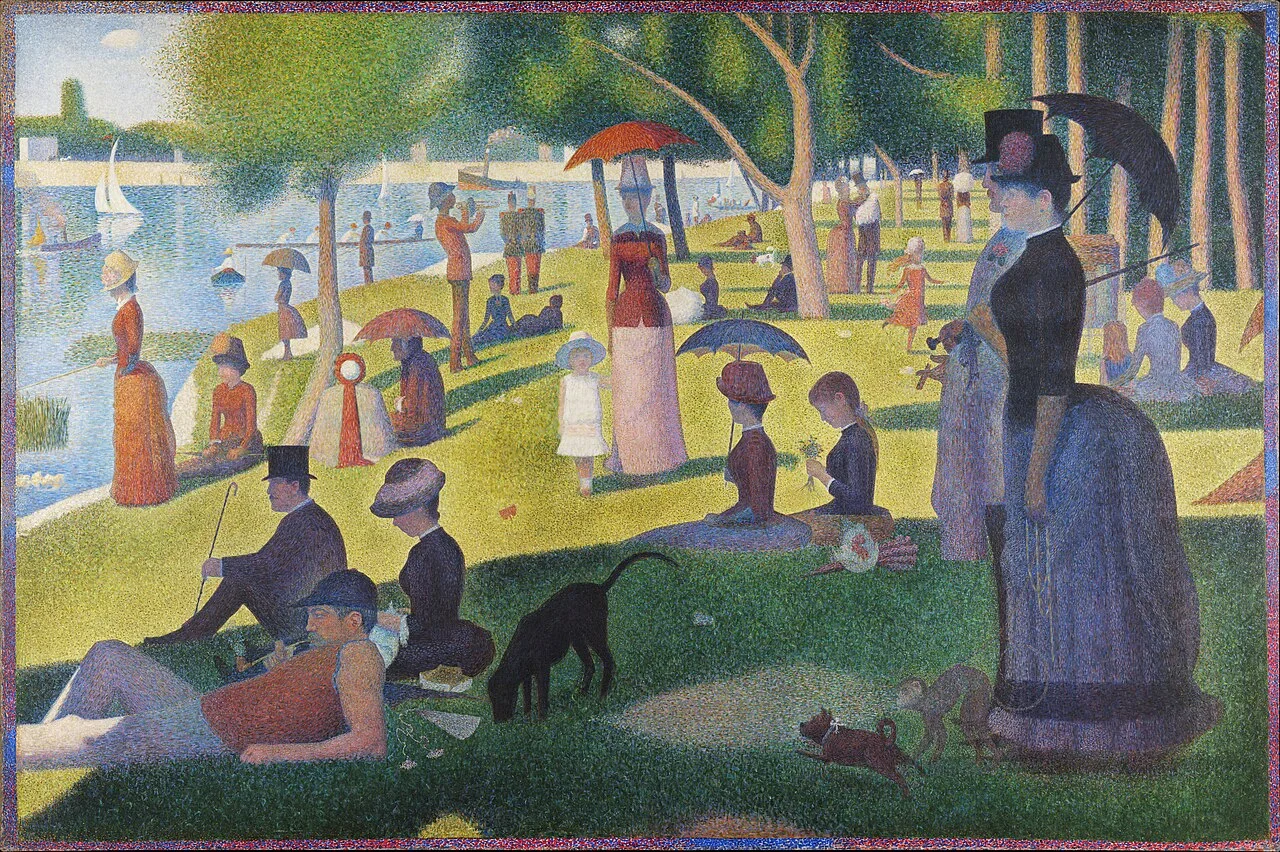
Georges Seurat's "A Sunday Afternoon on the Island of La Grande Jatte" is more than just a pretty park scene; it's a revolutionary masterpiece that redefined the art world.
The artwork transports us to a sunny Sunday on an island in the Seine, just outside of Paris. Seurat meticulously captures the leisure of Parisians enjoying their day off, depicting a diverse crowd of individuals – from fashionable couples and fishermen to soldiers and families with children – all rendered with remarkable detail and a sense of serene stillness. This painting serves as a window into the social life of late 19th-century France and provides valuable insight into the cultural values and leisure activities of the era.
Beyond its social commentary, "La Grande Jatte" holds immense historical significance as a cornerstone of the Neo-Impressionist movement and a prime example of pointillism. Inspired by scientific color theories, Seurat abandoned traditional brushstrokes, opting instead for meticulously placed dots of pure color. This innovative technique, initially called Divisionism, allowed colors to optically blend in the viewer's eye, creating a vibrant and luminous effect unlike anything seen before. This radical approach challenged artistic conventions and paved the way for future generations of artists to explore the possibilities of color and perception. The size of the painting (approximately 2 by 3 meters) further amplified its impact, showcasing the ambition and scope of Seurat's artistic vision.
The significance of "A Sunday Afternoon on the Island of La Grande Jatte" extends beyond its historical context and artistic innovation. It serves as a testament to the power of art to capture a specific moment in time, reflect social dynamics, and push the boundaries of artistic expression.
Look closer
Seurat approached painting almost like a scientist. Instead of mixing colors on a palette, he placed pure colors side by side so the viewer’s eye would mix them optically. The result changed the future of modern painting and influenced everything from Impressionism to digital pixels.
Worth the journey?
Yes — absolutely worth the trip. This is one of those artworks that changes depending on how you look at it. From a distance it feels peaceful and timeless; close up it becomes radically experimental.
Seeing it in person is essential because no photograph fully captures the vibration of the color and scale.
See it like an Artlover
Start from the far end of the room and slowly walk toward the painting. Watch how the image transforms from a perfectly clear Sunday scene into an abstract surface of colored dots. Spend a few minutes moving back and forth — that movement is part of the experience.
Artlovers Tip:
Most visitors focus on the famous central figures, but look at the shadows and grass instead. That’s where Seurat’s technique becomes almost hypnotic. The closer you get, the more modern the painting feels — surprisingly close to photography, screens, and pixels today.
A Sunday Afternoon on the Island of La Grande Jatte
Hours & rating from Google