At a glance
Meet the artist
Why go
Discover an emotionally powerful installation rooted in Al Solh’s childhood during the Lebanese Civil War.
See embroidery used as storytelling, resistance and collective memory.
Explore how personal experiences can preserve histories often reduced to statistics or news reports.
Encounter an important contemporary artist who represented Lebanon at the 2024 Venice Biennale.
You'll see
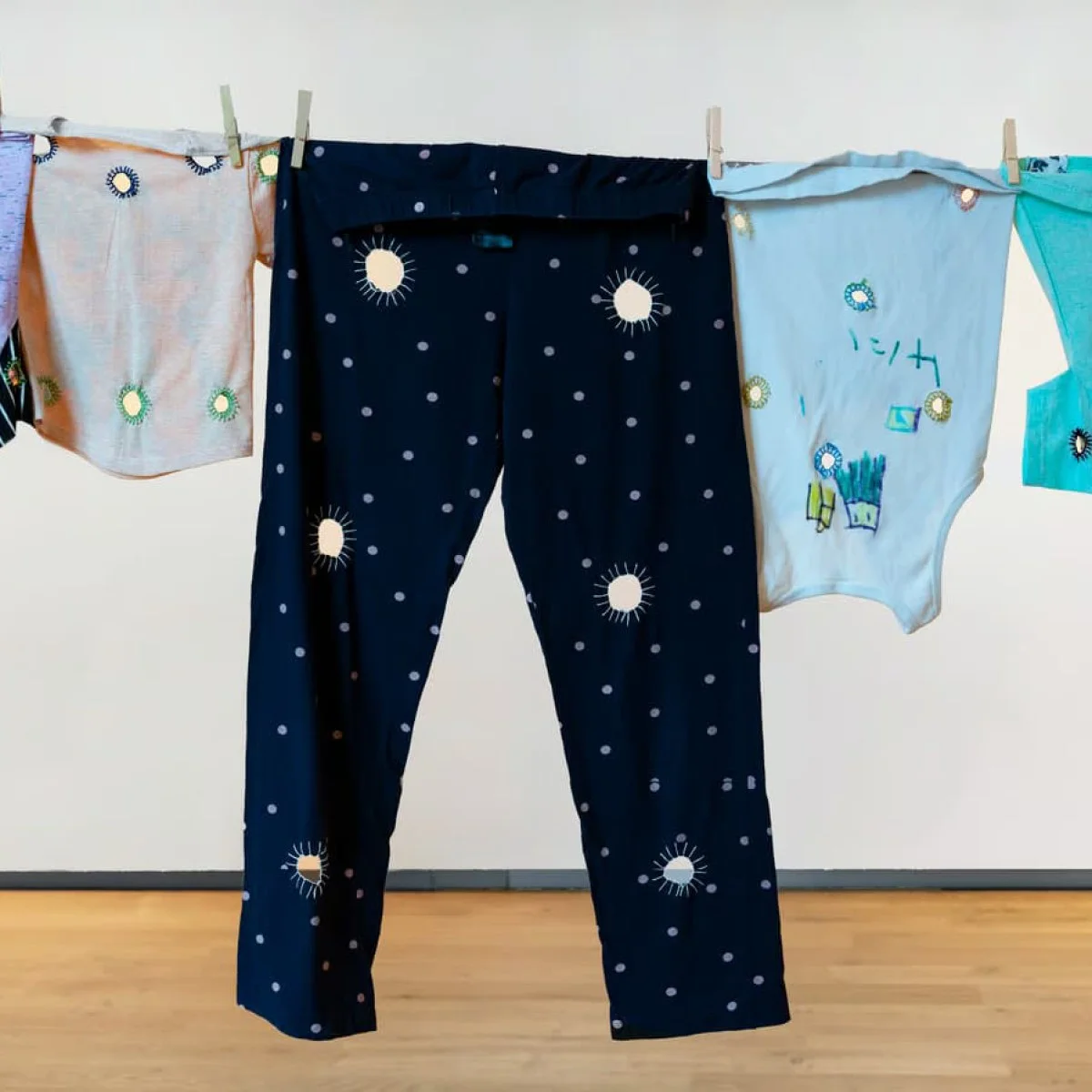
The exhibition centres on Nami Nami Noooom, Yalla Tnaaam, a textile installation made from nightclothes punctured with small holes and surrounded by colourful embroidery. The work developed from a childhood memory: unable to sleep during bombardments, Al Solh was encouraged by her mother to cut and stitch her pyjamas as a calming ritual.
Years later, the artist transformed that private gesture into a collaborative project with women in Lebanon and the Netherlands. Textile pieces are accompanied by cut-out paintings, drawings and the sound of children singing lullabies to their parents.
Pace of visit
The exhibition is compact, but the individual stories and textile details reward slow viewing.
Don't miss
- Nami Nami Noooom, Yalla Tnaaam
- The embroidered openings deliberately left visible rather than repaired
- Al Hanin (Girl on a Van 1980’s Beirut), depicting a woman dancing defiantly above a city shaped by conflict
- The soundtrack in which children reverse the traditional relationship by singing lullabies to their parents

Artlovers Tip
A small exhibition with considerable emotional weight.
This is not a blockbuster or a comprehensive survey. Its power comes from proximity: garments, voices and individual stories turn distant political conflict into something bodily and personal.
Look closely at the holes in the garments. They are not concealed: embroidery transforms each opening into something resembling an eye, sun, mouth or wound.
Inside the exhibition
“Yalla tnam, yalla”—approximately “Come on, sleep, come on”—comes from a lullaby familiar across Lebanon and Syria. Al Solh treats it not simply as language but as rhythm, memory and physical reassurance.
Throughout the exhibition, Arabic moves into Latin script, languages mix and stories travel between Beirut, Amsterdam and Barcelona. Al Solh rejects the idea of language or identity as something fixed, using mistranslation, humour and hybrid forms as creative possibilities.
Born in Beirut in 1978, Mounira Al Solh lives and works between Beirut and Amsterdam. Her multidisciplinary practice spans textiles, painting, drawing, installation, sculpture, video, writing and performance.
Personal testimony and individual “micro-histories” are central to her work, particularly the experiences of women, migrants and people living through conflict. She represented Lebanon at the 60th Venice Biennale in 2024 and has exhibited at Serralves, Bonnefanten, BALTIC, the Mori Art Museum and the Art Institute of Chicago.